Cabarrus Amateur Radio Society

Cabarrus County, Concord, NC


The Case for CW
Why Morse Code Still Matters for DXing and Contesting
Morse code — known in amateur radio jargon as CW — is the oldest digital mode on the HF bands. It predates SSB voice, datamodes, and all modern software-defined tricks. And yet, in 2025, CW still holds a place of honor among serious DXers, contesters, and weak-signal operators. Why? Because when the bands are tough, the antennas modest, and the stakes high, CW delivers performance that other modes, even digital ones like FT8, simply can’t match in certain contexts. In this article, we’ll talk about:
  • CW’s operational advantages
  • Typical speeds operators need for casual and competitive use
  • Learning CW — methods, software, and effective practice
  • A realistic comparison of CW vs FT8 in terms of signal-to-noise ratio (SNR) and receiver bandwidth — including 2700Hz, 500Hz, and 270Hz IF filters


What CW Actually Is (and Isn’t)

CW is just on–off keying of a radio carrier — you send a series of dots and dashes that your brain learns to translate into letters and words. On the air, you’ll hear a steady tone that goes dit or dah depending on how long the transmitter is keyed. That simplicity is its strength. The entire RF power is concentrated into a very narrow spectral footprint — literally a couple of tens hertz — compared to thousands of hertz for SSB voice.

Why CW Works So Well in DX and Contest Environments
1. Narrow Bandwidth = Better Weak-Signal Performance
Operator copy of a CW signal underwater or just above the noise floor often beats voice or wide digital modes because:
  • Less noise enters the receiver when your filter is narrow.
  • Human brains are extraordinarily good at pattern recognition for CW tones.
On a crowded HF band where every kilohertz seems occupied, a CW signal that sits in a couple hundred hertz still pokes through. That’s a practical advantage you feel when you’re fighting QRN or QRM.

2. Concentrated Power
On voice modes like SSB, only part of your transmitter’s power contains intelligible information; a lot of it is just a sideband. CW’s on/off keying, by contrast, means all your transmitter power goes into the signal that matters — improving readability under weak conditions.

3. Efficiency Under Load
In contests and pile-ups, CW’s narrow footprint lets many more stations fit into a band segment compared to voice. This isn’t theoretical: CW contests often pack hundreds of stations into a few kilohertz. They do it because narrow filters and selective tuning make that chaos workable for the human ear and brain.

4. Precision
When a rare DXpedition comes on with a mile-wide pileup, CW pile-up tactics require finesse:
  • “Listen up five”
  • “QRS?” (send slower)
  • Catching a fast callsign amid dozens of others
These aren’t just game tactics — they’re practical skills that pay off when there are thousands of stations calling at once.
SSB vs. CW
A useful analogy for understanding the fundamental difference between SSB and CW is to think in terms of pressure versus force.

Imagine pressing your finger into the palm of your hand with a certain amount of force — the sensation is noticeable, but spread out over a broad area. That is SSB: the transmitter’s power is distributed across several kilohertz of bandwidth.

Now imagine applying the same force through the sharp tip of a needle. The total force has not changed, but the pressure at the point of contact increases dramatically. That is CW. By concentrating essentially all transmitted energy into a very narrow bandwidth, CW produces a higher effective signal density at the receiver.

In practical terms, this is why CW signals (or FT8) remain readable at power levels and propagation conditions where SSB simply dissolves into the noise. The physics are the same; only the distribution of energy is different — and in weak-signal work, distribution matters as much as raw power.


Typical CW Operating Speeds — What You Need to Know
One common question is: “What speed should I be comfortable with before I even think about DX or contests?”
Based on Reverse Beacon Network (RBN) data and operator experience:

  • Casual QSOs / DX casually — ~15–25 words per minute (WPM) is very workable.
  • General DX work — many operators aim for ~20+ WPM so they can comfortably copy callsigns and reports without lag.
  • Contesting / pileups — top operators often run ~30–35 WPM for competitive exchange rates.
  • High-end serious ops — some go well above 35 WPM, but this is a minority and not necessary for most excellent CW operation.

For reference, many RBN CW reports put the average CW speed during regular operating around 25 WPM, with a bump above that in contests.

Why These Speeds Matter
Unlike FT8 or digital modes where the software assembles the message, CW puts the onus on the operator. If callsigns and signal reports are coming at you at 30 WPM, you need to recognize patterns faster than you could at 15 WPM — and that comes from practice.

Learning Morse Code: Tried and True Methods
Learning Morse isn’t like memorizing a frequency or button click. It’s learning a sound language. Here are the recognized ways operators make that happen:

1. Koch Method
This is one of the most respected training techniques: you learn a few characters at full target speed and gradually add more as your proficiency grows. This is how many clubs and courses teach CW because you internalize the tone patterns rather than memorizing dots/dashes visually.

2. Farnsworth Spacing
Letters are sent at a faster speed but spaced wider apart so you train your brain to recognize patterns while still having time to process them.

3. Immersion via Practice and Air Time
There’s no substitute for listening to real CW on the bands and trying actual QSOs. Even if your speed isn’t fast yet, the brain begins to recognize familiar call signs and letter sequences. Handling real pile-ups is part of the skill. Experienced operators recommend daily practice — often just minutes — more than occasional marathon sessions.

Tools and Software That Help You Learn
Here are practical tools that experienced ops use:
  • LCWO.net – browser-based training with Koch courses and call sign drills.
  • G4FON Morse Trainer – a classic program that teaches at set speed ranges.
  • ARRL CW resources – code practice audio (W1AW code runs at various speeds) and structured courses.
  • RufzXP – random call sign practice with adjustable speed — excellent for contest training.
  • CW Skimmer – while it decodes multiple CW signals on-the-fly (Windows), it also teaches you real-world pattern recognition and can be used as a training mirror.
  • Sound-card apps and mobile apps (e.g., Morse Mania) are great for casual practice and repetition.

Bottom line: No single method works for everyone. Start slow, build muscle memory, and use what keeps you consistent.

CW vs FT8: SNR, Filters, and Real Conditions
It’s impossible to talk about the modern CW world without acknowledging FT8 and similar weak-signal digital modes. They have taken the HF world by storm with automated decoding and unbelievable weak-signal thresholds. But comparing CW and FT8 is like comparing hand-flying a sailplane to flying an autopilot-equipped airliner — both have roles, but they’re different tools.

FT8’s Weak-Signal Claims
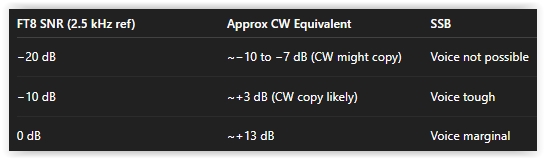
FT8, a digital mode part of the WSJT-X suite, can decode signals down to roughly −21dB SNR in a 2.5 kHz reference bandwidth thanks to heavy forward error correction.

That sounds impressive, but you have to frame it in context:
  • The SNR comparison used a wide reference bandwidth of 2500Hz.
  • Narrower filters make a huge difference to noise pickup.

A common practical rule of thumb is:


CW doesn’t magically copy below the noise in the FT8 sense because humans aren’t digital decoders, but a CW signal that is very weak in a voice-style passband often becomes readable with a CW-optimized filter.

Why Filters Matter
  • 2700Hz filter (typical “wide” IF) — mostly used for SSB, not ideal for CW. Noise floor high, weak CW signals get buried, and receiver AGC may kill a weak DX in presence of strong signal 500Hz away.
  • 500Hz CW filter — a happy medium: significantly lowers noise, lets CW signals pop out even if they are faint.
  • 270Hz (or narrower) CW filter — the gold standard for DX and pile-ups: massive noise reduction and great selectivity between crowded signals.

If your receiver is feeding a narrow CW filter (say 250–300Hz), the effective SNR improvement can be many dB compared to a wide 2.5 kHz passband. That’s real world: you’ll hear signals that on FT8 show up but on SSB vanish, in other words comparable to FT8, or even better.

Real World Behavior
The digital decoders used by FT8 are powerful because they assume perfect timing and known message structures. But during a contest or real two-way CW QSO, you’re dealing with imperfect propagation, Doppler, QSB (fading), splatter, and pile-up dynamics. CW operators use filter tuning, AGC tweaks, and dynamic ear training to extract callsigns and signal reports — and this is where manual CW operation still shines.

FT8 will find signals you can’t hear with your ear. But it won’t help you navigate a 100-station pile-up at 30+ WPM trying to earn that multiplier.

DSP Noise Reduction: Where CW Gains a Real Advantage
Modern DSP-based spectral noise reduction can further tilt the field in CW’s favor — and this is a real, measurable advantage in human operation.

Unlike FT8 decoders, which rely on fixed symbol timing and coherent integration over long intervals, DSP noise reduction works by suppressing statistically uncorrelated noise while preserving tonal components — exactly what a CW signal is. When properly adjusted, spectral NR can:
  • Improve effective CW readability by several additional dB
  • Reduce listener fatigue
  • Enhance copy of fading or fluttery signals
  • Preserve timing and rhythm that the brain uses for recognition

This processing does not create signal energy out of nothing — it reshapes the noise spectrum in a way that human auditory processing can exploit, especially when combined with narrow IF filtering and operator expectation.

In marginal conditions, experienced CW operators regularly copy signals that:
  • Do not sustain the stable timing FT8 requires
  • Drift slightly in frequency
  • Suffer selective fading across the FT8 symbol window
  • Appear intermittently rather than continuously for 12+ seconds

In those cases, FT8 may fail to decode while CW remains readable, particularly for short, structured exchanges such as callsigns and contest reports. This is not because CW is mathematically superior to FT8 as a modem, but because human pattern recognition combined with narrow filtering and adaptive DSP is extraordinarily resilient under real HF propagation conditions.

What CW Teaches You as an Operator
One intangible advantage often overlooked is operator skill:
  • understanding propagation nuances
  • anticipating call exchanges
  • mastering pile-up strategy
  • trained ear for real propagation anomalies
Contest operation is not just about making contacts — it’s about doing it faster, under pressure, and with less margin for error. CW forces you to refine these skills more than an automated digital mode ever will.

Conclusion
Here’s the brass tacks summary:
  • CW’s narrow bandwidth and efficient use of power make it a formidable mode for weak signals and crowded bands.
  • Typical operating speeds today range from ~15WPM for casual DX up to 30+WPM for high-end contests.
  • Learning CW takes commitment, but modern tools — LCWO, Morse trainers, audio practice, and decoder aids — make it more accessible.
  • CW vs FT8 is not apples-to-apples — FT8 shines at ultra-weak signals in automated decode environments, while CW excels in human-paced, skill-rich contexts like DX pile-ups and contests.
  • Filters matter — a 500Hz or narrower (my personal choice is 270Hz) IF filter dramatically lifts CW performance in noise compared to a typical wide SSB passband.

If you want a mode that teaches you radio fundamentals, challenges you to improve, and still beats others in contested, weak, or busy conditions — CW is that mode. It’s not “old school” for nostalgia’s sake — it’s practical, relevant, and still a core part of the HF amateur experience.


References:

CW Adventage - The FT8 AGC Problem
One of FT8’s least-discussed limitations appears when a very weak FT8 signal coexists with one or more strong local signals inside the receiver passband. This situation is increasingly common on crowded HF bands, especially during contests or evening openings on 40 and 20 meters.

At the heart of the issue is receiver gain distribution and AGC behavior, not the FT8 mode itself. AGC Was Designed for Human Ears, Not Digital Decoders.

Most amateur receivers — including modern SDRs — implement AGC (Automatic Gain Control) based on total signal energy present within the IF or DSP passband. AGC does exactly what it was designed to do for voice and CW operation: prevent overload and keep audio levels comfortable for human listening.

But for FT8, this creates a mismatch:
• A strong local station anywhere in the passband raises the average signal level.
• The AGC responds by reducing receiver gain.
• That gain reduction applies equally to all signals, including the weak FT8 signal you actually want to decode.

The result is that the weak FT8 signal is pushed closer to (or below) the ADC’s effective noise floor, even though it might otherwise be decodable in the absence of the strong signal.

Why FT8 Is More Vulnerable Than CW Here: FT8 decoders assume:
• Stable signal amplitude over the integration interval
• Reasonable dynamic range at the ADC input
• Minimal gain pumping during the 12.64-second decode window

AGC gain pumping caused by a strong nearby signal breaks these assumptions. Even slow AGC can introduce small but continuous gain fluctuations that reduce decode probability — especially for signals already near the threshold.

CW operators, by contrast:
• Commonly disable AGC or run it very slow
• Use narrow IF filters to isolate the desired signal
• Mentally ignore amplitude pumping while tracking tone patterns

A CW signal that rises and falls due to AGC action is often still copyable by ear, while the same variation can cause FT8 decode failure. Strong

Signals Outside the FT8 Tones Still Matter.

Another subtlety is that AGC does not care whether the strong signal overlaps the FT8 tones. A loud CW or SSB signal anywhere in the receiver’s active bandwidth can reduce gain enough to prevent FT8 decoding — even if spectral plots show the FT8 tones as “clear.”

This is why operators sometimes see an FT8 signal:
• Visible on the waterfall
• At an apparently adequate SNR
• Yet producing no decodes

The decoder never sees enough stable dynamic range to integrate the signal successfully.

Why Manual Gain Often Works Better for FT8:
Experienced FT8 operators quietly avoid AGC altogether:
• AGC is set to off or fixed
• RF gain is manually adjusted so the noise floor sits comfortably above the ADC floor without clipping
• This preserves weak-signal linearity even in the presence of strong locals

This technique mirrors classic CW operating practice — and it works for the same reason.

Contrast With CW in the Same Scenario
In the exact same RF environment:
• A strong local station may make FT8 decoding impossible due to AGC compression
• Yet a CW operator, using a 270 Hz filter and fixed gain, may still copy a weak signal by ear

This is not because CW is “more sensitive” in an absolute sense, but because CW decoding is tolerant of non-ideal receiver behavior, whereas FT8 decoding is not.

Bottom Line
FT8 excels when:
• The band is quiet
• Signals are evenly distributed
• Receiver gain remains stable

But in the presence of strong local signals, AGC action can effectively erase FT8’s theoretical weak-signal advantage. CW, aided by narrow filtering, fixed gain, and human pattern recognition, often remains usable — sometimes decisively so — under precisely these imperfect real-world conditions.

This is one more reason why seasoned DXers and contesters continue to rely on CW when bands are crowded and conditions are less than ideal.


This article is reprinted with permission of the author, Christopher Krstanovic - AI2F.
About Author
Christopher Krstanovic, AI2F, is a lifelong amateur radio operator, first licensed in the US in 1980s as WR1F. He holds degrees in Physics and a PhD in Electrical Engineering, and his career has spanned corporate engineering as well as technology entrepreneurship. After leaving corporate America, he founded and led three companies before returning to active amateur radio under his current call sign. His operating interests include HF, antenna design, practical radio engineering, Astronomy.


Copyright 2026 © Cabarrus Amateur Radio Society. All Rights Reserved.