Cabarrus Amateur Radio Society

Cabarrus County, Concord, NC


Introduction to VHF/UHF FM and Repeater Operation
This article is written for new amateur radio operators who are trying to make sense of VHF and UHF FM operation, particularly repeaters. When I say “VHF” here, I’m talking everything from 6 meters upward, including UHF. The examples and habits described are based on real operating experience on the East Coast with some specifics drawn from New Hampshire. Your local practices may vary—and that’s exactly why the first skill every new ham needs is listening.


Spend time monitoring your local repeaters and simplex frequencies before jumping in. Figure out how people actually operate where you live. Then copy the good operators and consciously avoid the bad habits. Poor operating isn’t limited to newcomers; plenty of long-licensed hams should know better and don’t. Learn by observation and aim higher.


Repeater Operation: How It’s Different
Repeaters change the nature of communication. Signals are usually strong, audio is clear, and range limitations are largely removed. As a result, many HF habits simply aren’t necessary—or helpful—on VHF FM.


Getting on the Repeater
If you want to see whether anyone is around, tune up the repeater and make a short, clear call. Long CQ-style calls are unnecessary. A simple: “K4XYZ monitoring.” is enough. That tells everyone you’re available to talk without demanding attention.

If you need something specific—signal check, road conditions, weather, assistance—say so. People are far more likely to respond to a clear request than to a vague call for conversation.

Identification: Do It Early, Do It Often
FCC rules require identification at least every ten minutes and at the end of a contact. Good operators ID when they first come on as well. That removes ambiguity and lets others know immediately who they’re hearing. There’s no downside to early identification—only upside.

Breaking Into an Existing Conversation
Repeaters are shared resources. No one owns the frequency, no matter how long they’ve been talking.
The proper way to break in is simple: give your call sign between transmissions. That’s it. No speeches. No drama.
The word “break” is controversial for good reason. In many emergency groups, it’s reserved strictly for urgent or emergency traffic. Using your call sign avoids confusion and allows net control or other operators acknowledge you cleanly.

Pauses between transmissions matter. Most repeaters include a courtesy tone specifically so others can break in and so the repeater doesn’t time out. If you ignore it, you’ll eventually shut the machine down—usually in the middle of your sentence.

Keep the Language Plain
FM repeaters do not require heavy jargon. Overusing Q-signals, phonetics, and procedural clutter just wastes airtime. Plain English works. Clear speech works. The goal is communication, not performing amateur radio theater.

What Repeaters Are Actually For
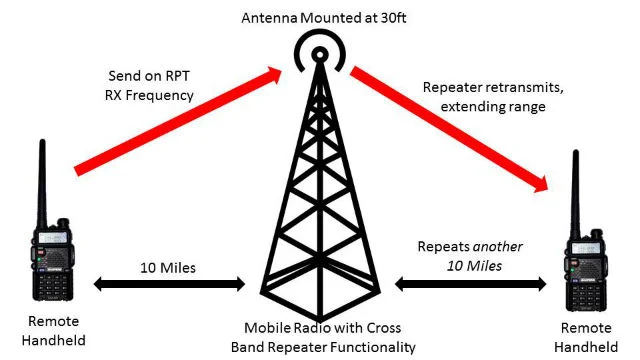
At their core, repeaters exist to extend the range of handhelds and mobile stations. Fixed stations with decent antennas often don’t need them—but they’re commonly used anyway. That’s fine, as long as people remember that repeaters are finite shared infrastructure.

If you’re talking to someone you can easily reach on simplex, move off the repeater—especially for long conversations. Wide-area repeaters, in particular, should be treated like the valuable assets they are.
Courtesy matters. Yield the repeater when someone needs it. Don’t interrupt ongoing QSOs without reason. Assume your conversations are being monitored by both licensed and unlicensed listeners—because they are. When you’re out of anything useful to say, sign off. Common sense and courtesy solve almost every repeater problem.

Simplex: Don’t Ignore It
Repeaters are useful—but they aren’t the whole band.

Simplex is direct station-to-station communication without a repeater in between. Range depends on antenna height, antenna quality, and terrain. Two mobiles on flat ground can typically manage 10–20 miles. Get one station elevated and the distance increases dramatically. Line-of-sight physics still rules.

Simplex is also more interesting. There’s real satisfaction in seeing how far your station can reach on its own. Conversations tend to be longer and more focused because fewer people are listening in. It feels more like radio and less like a party line.

For serious simplex work, FM is only the beginning. SSB and CW dominate weak-signal VHF operation for good reason. That’s a deeper topic—but one well worth exploring.
Try simplex. You’ll be glad you did.

Making Contacts Without Getting Discouraged

At some point, you’ll call and nobody will answer. Then it will happen again. New operators often assume they’re being ignored. Usually, that’s nonsense.

Many experienced hams are creatures of habit. They talk to their friends. They check into their nets. They aren’t scanning constantly for new voices. That’s not hostility—it’s routine.

Don’t take it personally. Listen more. Answer others instead of always calling. Bring something to the conversation besides a radio model number and power level. Better yet, meet people in person through local clubs, Field Day, public service events, or volunteering. Once you know people face-to-face, the on-air contacts follow naturally.

Nets: Organized Radio on Purpose


A net is simply a scheduled, organized on-air meeting with a defined goal—emergency coordination, weather spotting, traffic handling, or club activity. Most VHF/UHF nets operate on repeaters and welcome newcomers.
Follow the net control station’s instructions. That’s not negotiable. Nets work because someone is steering the ship.

Cabarrus County
Concord–Kannapolis Repeater Net
  • 146.655 MHz (–600 kHz), CSQ
  • Sundays around 20:30 (informal check ins)
  • Local community ragchew
HEARS / Concord Net
  • 147.210 MHz (+600 kHz), Tone 110.9
  • Mondays 20:30
  • Part of the HEARS linked system
Cabarrus ARES Net
  • 147.300 MHz (+600 kHz), Tone 136.5
  • Tuesdays 20:00
  • ARES training and announcements
Cabarrus ARES UHF Net
  • 146.655 MHz (-600 kHz), CSQ
  • Tuesdays 20:30 (immediately after the VHF net

Rowan County
Rowan County ARES Training Net
  • 145.410 MHz (–600 kHz), Tone 136.5
  • Wednesdays 20:30
  • Directed emergency readiness format

Regional Nets Covering Cabarrus and Rowan Counties
China Grove Wide Coverage Net
  • 145.410 MHz (–600 kHz), Tone 136.5
  • Wednesdays 20:30
  • Strong footprint across both counties
443.250 Regional FM Network
  • 443.250 MHz (+5 MHz), Tone 136.5
  • Sundays 21:00
  • Wide area coverage and mixed traffic

Daily North Carolina Traffic Nets (FM / VHF)
• Southeastern NC Traffic Net – 147.045 MHz (+), no tone, 20:00 daily
• Eastern NC Traffic Net – 146.685 MHz (–), 88.5 Hz, 20:30 daily
• Piedmont Coastal Traffic Net – 146.880 MHz (–), no tone, 21:00 daily
• Central NC Traffic Net – 146.820 MHz (–), 94.8 Hz, 21:30 daily
• Central Western NC Traffic Net – 145.150 MHz (–), 100.0 Hz, 19:00 daily
These five nets form the backbone of the North Carolina NTS (National Traffic System) on FM.

Popular Statewide & Wide Coverage FM Nets
• Vagabond Ragchew Net – 145.470 MHz, Mon/Tue 14:30
• Insomniacs Roundtable – 145.250 MHz, Tue 01:00
• New Hams Net – 145.270 MHz, Mon 19:00
• Helping Hands Net – 146.865 MHz, Mon 20:00
• Randolph ARC Net – 147.255 MHz, Mon 20:00
• Alamance County Net – 146.670 MHz, Tue 20:00
• Stokes County Preparedness Net – 146.790 MHz, Tue 20:00
These nets are heard across large portions of the state and are excellent for new operators.

Greensboro / Triad Nets with Wide State Reach
• GARA Technical Forum – 145.150 MHz, Sun 19:30
• GARA News & Information Net – 145.150 MHz, Sun 21:00
• Central NC Traffic (Late Session) – 146.820 MHz, Sun 21:30
The 145.150 and 146.820 repeaters have strong coverage and are commonly monitored statewide.

Linked & Multi County FM Systems
These aren’t single nets but host many FM nets heard across NC:
• NCPRN (UHF FM Linked System) – Dozens of repeaters statewide
• HEARS System (UHF/VHF) – Public service oriented linked repeaters
• Western NC Linked FM Network – Covers foothills and mountain counties
• Charlotte Area Linked Repeaters – Strong coverage into Cabarrus, Rowan, and beyond
These systems are ideal for monitoring during severe weather or major events.

How to Use This List
  • Start with the daily traffic nets — they teach excellent net discipline.
  • Add local club nets in your county for community connection.
  • Monitor wide coverage nets to hear activity across the state.
  • Keep an ear on linked systems during storms or emergencies.


Choosing Which Nets to Monitor
With so many repeaters and nets available, new operators often wonder which ones they should listen to first. The best approach is to focus on nets that match your interests, your location, and the type of operating you want to learn. Monitoring a variety of nets also helps you understand local operating practices, emergency procedures, and the personalities of the amateur radio community in your area.

Types of Nets to Consider
• Emergency & Public Service Nets These include ARES, RACES, SKYWARN, and county emergency readiness nets. They’re ideal for learning structured net procedures, directed net etiquette, and how amateur radio supports real world emergencies. If you plan to volunteer or participate in public service events, these should be at the top of your list.

• Local Club Nets Most amateur radio clubs host weekly or monthly nets. These are friendly, informal, and great for meeting operators in your area. They often include announcements about club activities, training opportunities, and local events.

• Technical or Training Nets Some nets focus on specific skills such as digital modes, antenna building, emergency preparedness, or operating techniques. These are excellent for new hams who want to expand their knowledge.

• Social / Ragchew Nets These nets are relaxed and conversational. They’re perfect for getting comfortable on the air, practicing your operating style, and meeting people with similar interests.

• Wide Area Linked Nets Networks like NCPRN or statewide linked repeaters allow you to hear operators from across North Carolina and beyond. They’re useful for travel, severe weather monitoring, and staying connected during large scale events.

How to Prioritize Nets
  • Start with your county’s ARES net. This gives you a foundation in emergency net structure and local procedures.
  • Add your local club’s weekly net. It’s the easiest way to meet nearby operators and become part of the community.
  • Monitor nets on repeaters you can reliably reach. Strong, consistent signals make learning easier and reduce frustration.
  • Include at least one wide coverage or linked net. These nets help you understand how larger systems operate and give you more opportunities to hear activity.
  • Choose nets that match your interests. Whether you enjoy emergency communications, technical topics, or casual conversation, there’s a net that fits your style.

Why Monitoring Nets Matters
Listening to nets teaches you:
  • Local operating norms — how people identify, pass traffic, and interact
  • Emergency procedures — how directed nets work and how traffic is handled
  • Repeater behavior — courtesy tones, timeouts, linked systems, and coverage quirks
  • Community rhythm — when people are active and which repeaters are most used

For new operators, monitoring nets is one of the fastest ways to become confident and comfortable on the air. Over time, you’ll naturally gravitate toward the nets that best match your interests and operating goals.

Programming the Radio Correctly
If you can’t access a repeater, nine times out of ten it’s a programming issue. You need three things correct:
  • Frequency – the repeater’s output frequency
  • Offset – the correct transmit shift (+ or –)
  • Tone – the required CTCSS tone, if used

Get any of these wrong and nothing works. Period.

Testing Without Being “That Guy”
Whenever possible, test into a dummy load—and even then, don’t use repeater inputs. Dummy loads aren’t perfect, and sensitive repeaters can still be keyed unintentionally.

If you must test on the air, choose an unused frequency or a quiet simplex channel. If you want to check repeater access, say:
“K4XYZ testing.”

Never kerchunk. Unidentified transmissions are illegal, irritating, and often logged.
(And no, the repeater probably won’t actually set your radio on fire—but people will remember you.)

Interference: Handle It Correctly
Intentional interference is rare. Accidental interference is common.
If you hear deliberate nonsense—jamming, profanity, attention-seeking—do not respond. Acknowledgment is fuel. Ignore it.

If someone doubles or transmits accidentally, assume it was a mistake unless proven otherwise. Most of us have been there.

VHF/UHF Propagation in Plain Terms
Most VHF and UHF propagation is line-of-sight. Height matters. Terrain matters. That’s why repeaters live on mountains and towers.

Occasionally, propagation opens up via tropospheric ducting, Sporadic-E, or meteor scatter, allowing signals to travel far beyond normal limits. Most long-distance VHF work uses SSB or CW and lives at the low end of the bands. That’s a whole discipline of its own—and a very rewarding one.

Understanding FM Signal Reports
FM reports are based on quieting, not S-units. A fully-quieting signal has no background noise. Partial quieting is often described in percentages.

On a repeater, remember there are two signal paths: from the user to the repeater, and from the repeater to you. Your S-meter tells you nothing about how well the other station is getting into the machine.

FM deviation matters. Overdeviation makes signals worse, not better. Underdeviation produces weak audio. Keep it at 5kHz. Loudness at the receiver has little to do with RF power.

Phonetics and Q-Signals
FM is usually clear enough that phonetics aren’t required—but when clarity matters, use standard ITU phonetics. Nets often require them for good reason.

Q-signals exist, but on VHF phone they should be used sparingly. Plain language is usually better.

Emergencies: Be Useful, Not Dramatic
In real emergencies, cell phones are usually faster—when they work.
If you must use radio, be prepared to give:
  • Your exact location
  • Nearby landmarks or mile markers
  • Injury status

Consider joining ARES or RACES if emergency communication interests you. Training matters.

Band Plans and Frequency Discipline

VHF and UHF bands are shared between FM, weak-signal, satellite, digital, and experimental users. FM operators must stay out of weak-signal and satellite sub-bands. Band plans are regional. Learn yours. Follow it. That’s how interference is avoided and coexistence works.

2 Meter (144–148 MHz)
  • 146.655 MHz (–0.600 MHz) — Local analog FM repeater (K4CEB) serving Concord/Kannapolis.
  • 147.300 MHz (+0.600 MHz) — Cabarrus ARES repeater (N4JEX) with 136.5 Hz tone.
  • 145.410 MHz (–0.600 MHz offset, 136.5 Hz PL) — Rowan Amateur Radio Society repeater (China Grove)
  • 146.790 MHz (–0.600 MHz offset, 94.8 Hz PL) — Barber Junction / Young Mountain site

2m Simplex & Calling:
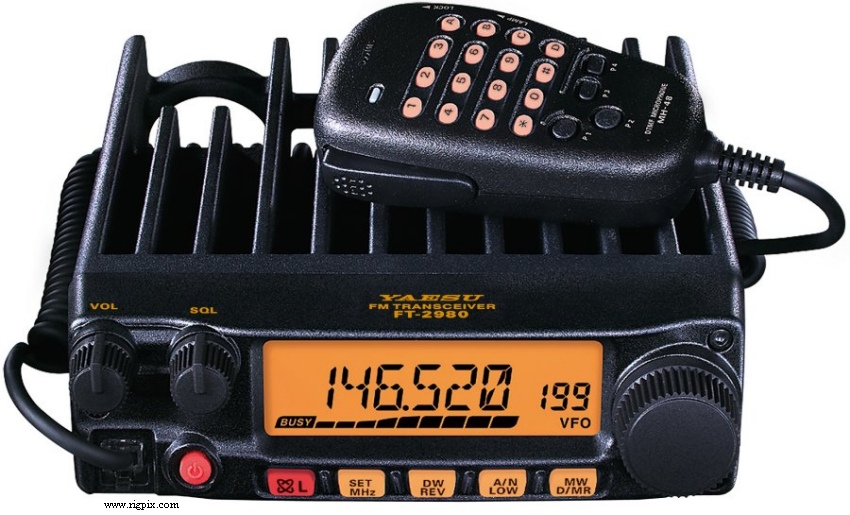
  • 146.520 MHz — National 2 m FM simplex calling frequency (standard everywhere).
  • 146.400–146.580 MHz — Common local simplex channels (general FM simplex range used by NC hams).

70 cm (420–450 MHz)
Local UHF repeaters often used by Cabarrus area hams:
  • 443.350 MHz (+5 MHz) — Cabarrus ARES UHF repeater with 136.5 Hz tone.
  • 443.250 MHz (+5 MHz) — Wide-coverage 70 cm repeater (often linked to local network).
  • 443.150 MHz (+5 MHz) —Wide-coverage UHF repeater that spills into the area from adjacent counties.
  • 442.925 MHz (–5 MHz offset, 127.3 Hz PL) — Youngs Mountain repeater

The offsets above are standard for local repeaters (–600 kHz on 2 m, +5 MHz on 70 cm) and tones (PL/CTCSS) are used to access the machines.

70cm Simplex & Calling:
  • 446.000 MHz — National 70 cm FM simplex calling frequency (standard).


Repeaters and Directories
Finding accurate repeater information is far easier today than it used to be. Several online directories and mobile apps maintain up to date listings for VHF/UHF repeaters across the United States and worldwide. These tools are invaluable when programming a new radio, traveling, or simply exploring what’s active in your area.

A few widely used resources include:
  • RepeaterBook — A free, community driven directory with excellent coverage of VHF/UHF repeaters. It offers a clean website and mobile apps for iOS and Android, allowing searches by band, mode, location, or features such as EchoLink and IRLP.
  • ARRL Repeater Directory Online — The ARRL maintains a national database of coordinated repeaters. The online version is updated more frequently than the printed book and incorporates data from ARRL affiliated coordination groups.
  • RFinder — A subscription based global repeater database with GPS aware apps and integration with certain radios for direct programming. It’s especially useful for operators who travel frequently or want a single worldwide source.
  • Local Coordination Bodies — Many states maintain their own official repeater coordination databases. These are often the most authoritative sources for regional frequency information.

These directories are especially helpful because repeater activity changes over time — new systems appear, tones change, and some machines go silent. Checking these resources periodically helps keep your radio’s memory channels accurate and useful.

North Carolina–Specific Repeater Resources
North Carolina has an active amateur radio community with excellent statewide repeater coverage. New operators in NC will benefit from checking the following region specific resources:
  • SERA – Southeastern Repeater Association SERA is the official repeater coordination body for North Carolina. Their database includes coordinated repeaters across the state, technical details, and coordination policies. SERA covers multiple southeastern states, but NC is one of its core regions.
  • NCPRN – North Carolina Public Safety & Amateur Radio Network A large linked repeater system covering much of the state, primarily on UHF. It supports wide area communication and is popular for both routine and emergency use.
  • NC PRN DMR Network For digital operators, the NC PRN network provides extensive DMR coverage with dozens of linked repeaters statewide. Their website includes talkgroup information, coverage maps, and programming guides.
  • Local Club Repeater Lists Many North Carolina amateur radio clubs maintain their own repeater lists, often more up to date than national directories. Examples include clubs in Charlotte, Raleigh, Greensboro, Asheville, and Wilmington. Checking your local club’s website is often the fastest way to find active repeaters in your immediate area.

These North Carolina–specific resources help new operators quickly find active repeaters, understand regional practices, and connect with the broader amateur radio community across the state.

Handheld Antennas: The Uncomfortable Truth
Rubber duck antennas are compromises. Convenient—but inefficient. Basically a leaky dummy load. Think of them as marginal antennas that work only because repeaters are forgiving.
If range matters, use a real antenna. End-fed half-wave handheld antennas are particularly effective and often dramatically improve performance.
Be aware: better antennas can overload handheld receivers in very high-RF environments, causing intermodulation and desense. External band-pass filters can help—but they block non-ham signals as well.

Final Thoughts
VHF and UHF FM are straightforward—but only when used properly. Listen first. Operate with intent. Respect shared resources. Learn simplex. Use good antennas. Avoid bad habits.
Do those things, and VHF/UHF stops being boring—and starts being real radio again.

Summary of Key Amateur Radio Terms
• ARES – A volunteer group that provides public service and emergency communications using amateur radio.
• Autopatch – Hardware that links a repeater to the phone system so hams can place phone calls over the air.
• Break – A request to interrupt an ongoing conversation, typically reserved for urgent or emergency traffic.
• Courtesy beep – A tone from a repeater indicating it has reset; operators should pause to allow others to join.
• CTCSS – Subaudible access tones (67–250.3 Hz) used to open certain repeaters.
• Digipeater – A digital repeater that retransmits packet radio signals.
• DTMF tones – Dual tone keypad signals used for control functions, similar to telephone Touch Tones.
• Duplex – Using separate transmit and receive frequencies, as with repeater operation.
• FM – A modulation method where information is carried by varying the signal’s frequency.
• Full quieting – A received signal with no background noise.
• Input frequency – The frequency a repeater listens on (and the user transmits on).
• Kerchunk – Keying a repeater without identifying; considered improper operating practice.
• Machine – Informal slang for a repeater system.
• Output frequency – The frequency a repeater transmits on (and the user listens on).
• PL tone – Motorola’s name for CTCSS access tones.
• RACES – A government affiliated emergency communications organization operating under specific regulations.
• Simplex – Direct radio to radio communication using the same transmit and receive frequency.
• Transmit offset – The difference between a repeater’s input and output frequencies, commonly ±600kHz on 2m


This article is reprinted with permission of the author, Christopher Krstanovic - AI2F.
About Author
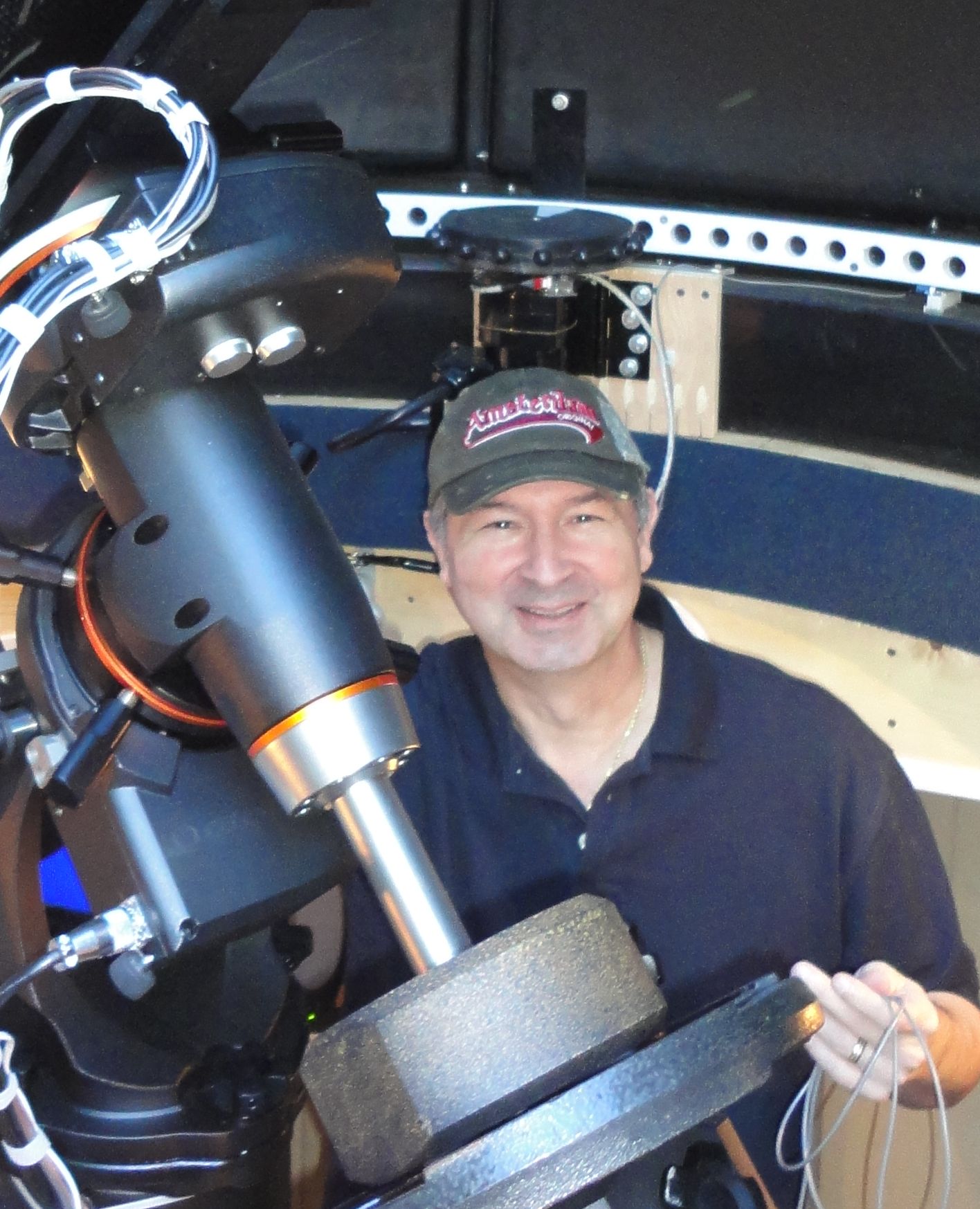
Christopher Krstanovic, AI2F, is a lifelong amateur radio operator, first licensed in the US in 1980s as WR1F. He holds degrees in Physics and a PhD in Electrical Engineering, and his career has spanned corporate engineering as well as technology entrepreneurship. After leaving corporate America, he founded and led three companies before returning to active amateur radio under his current call sign. His operating interests include HF, antenna design, practical radio engineering, Astronomy.


Copyright 2026 © Cabarrus Amateur Radio Society. All Rights Reserved.