A Fresh Look at Gray-Line DXing
Dramatically expand your DX opportunities:
Gray‑line DXing uses the brief twilight periods around sunrise and sunset, when ionospheric absorption drops and MUFs shift, to enable unusually strong long‑distance HF propagation. These short windows can open paths across entire hemispheres, offering rare and powerful DX opportunities for operators who time them well.
Grey line propagation often makes it possible to achieve long‑distance radio contacts with stations on the opposite side of the world, and the resulting signal strengths can be impressively strong.
Radio signals traveling long distances on the HF bands depend heavily on the ever changing behavior of the ionosphere. The most dramatic shifts occur during the daily transitions between night and day. For DXers who work multiple bands, understanding what happens during these twilight periods can make the difference between routine contacts and extraordinary ones.
HF propagation is shaped by several variables: the path between stations, the operating frequency, solar activity, and—most importantly for operators—time. While we cannot influence the sun or the geometry of a path, we can choose when and on which band to operate. Knowing how solar illumination affects the ionosphere helps operators match the right frequency to the right moment for any given path and level of solar activity.
Time itself is a multi layered factor. It includes the phase of the 11 year solar cycle, the season and Earth’s axial tilt, and the daily pattern of light, darkness, and twilight.
During the months of October through March, the northern polar region remains in continuous or near continuous darkness. This allows low and high frequency signals to travel across the pole between distant points in the Northern Hemisphere. A similar window opens in the Southern Hemisphere from March through October.
Summer behaves differently: HF bands open and close later in the day, and polar paths shrink mainly to 40–15 meters, while transequatorial routes dominate the low bands and 10 meters.
In general, the low bands (1.8–10 MHz) favor long distance work from the period just before sunset through the night and into the early morning. Higher frequencies (14–28 MHz) tend to come alive around sunrise, remain active throughout daylight, and fade after dark. These patterns shift with solar conditions, frequency choice, and season. Twilight, however, introduces its own special behavior—especially during the Northern Hemisphere winter.
The most favourable periods tend to occur around the spring and autumn equinoxes, when neither end of the communication path is affected by the more extreme propagation conditions of summer or winter. During these seasons, long‑range radio links can be established with distant stations at consistently high signal levels.
The Twilight Zone: Where Propagation Gets Interesting
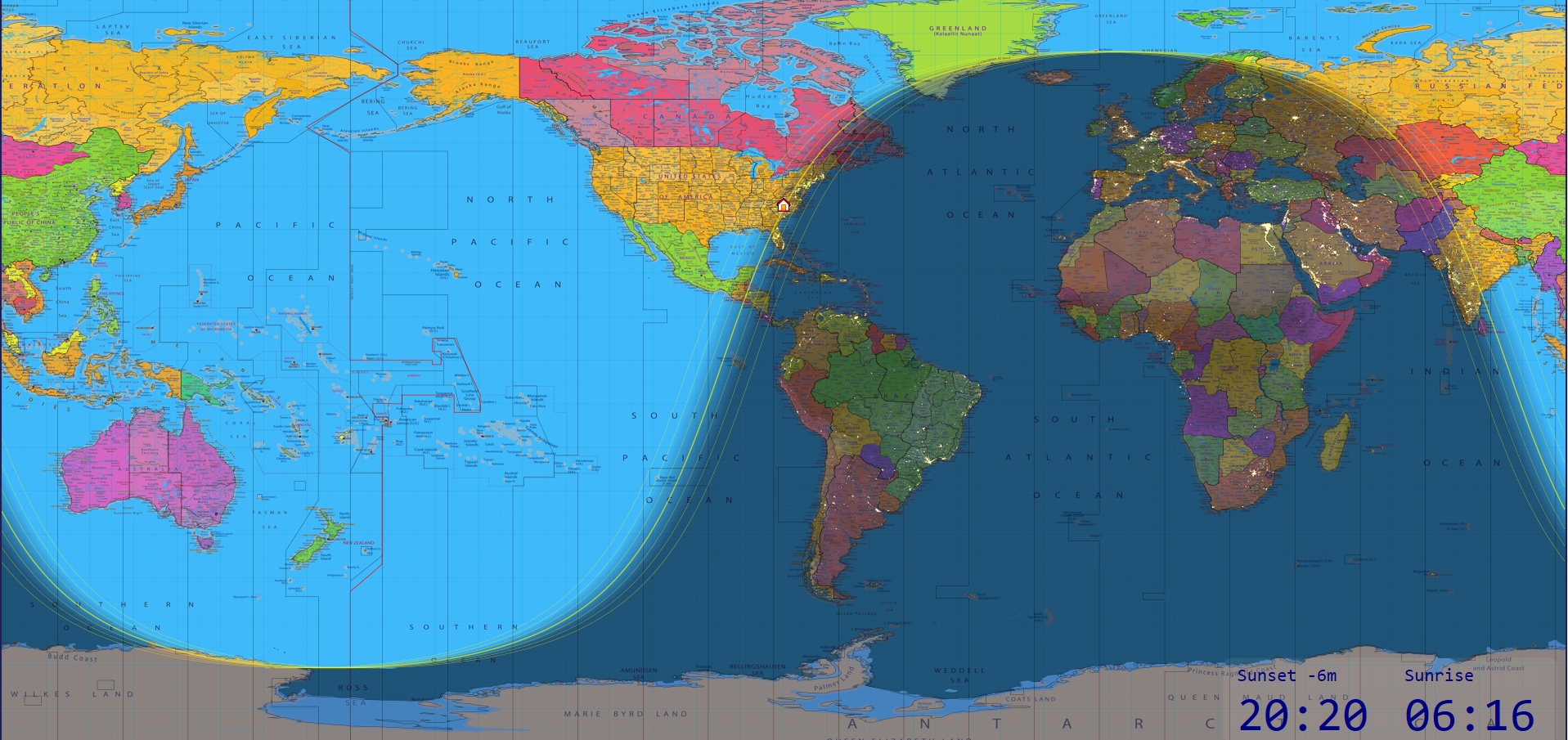
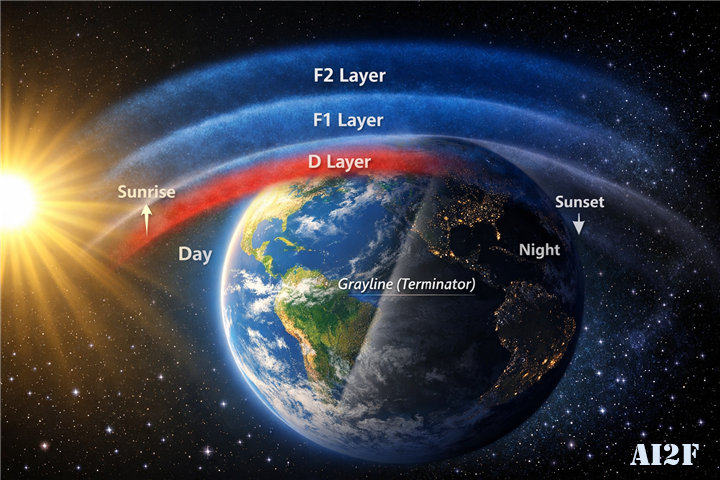
The boundary between night and day—often called the terminator, gray line, or twilight zone—forms a moving circle around the Earth. On the sunlit side, maximum usable frequencies (MUFs) are highest, but so is absorption from the energized D layer. Near the MUF, losses are lowest.
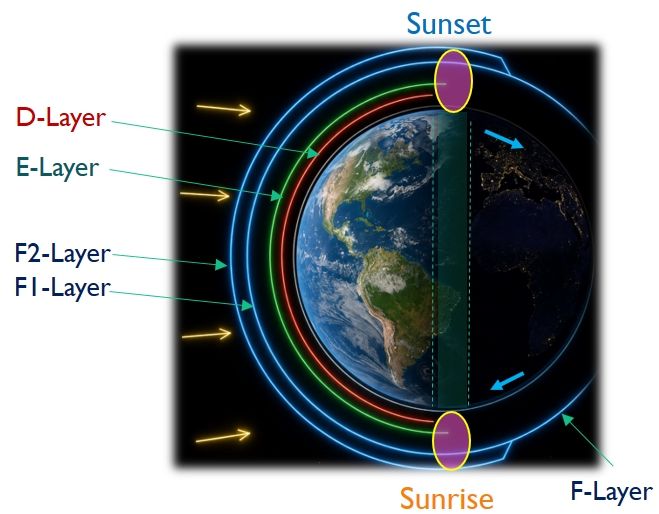
On the dark side, MUFs fall to roughly one third of their daytime values just before sunrise, and D layer absorption nearly disappears.
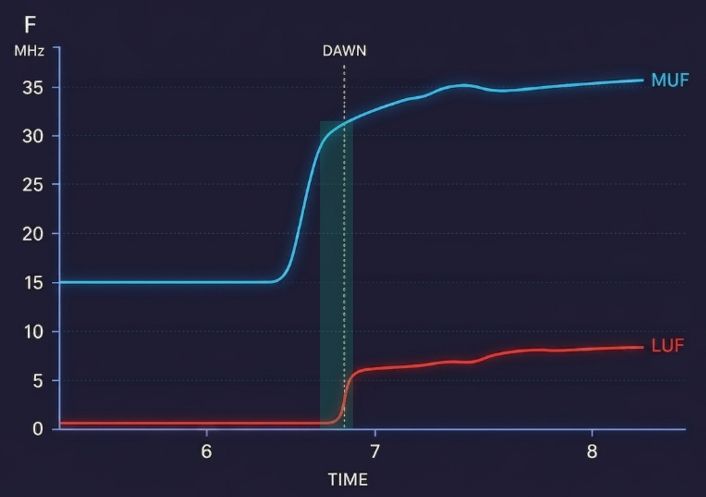
Propagation along the gray line is particularly remarkable. On the sunrise side, MUFs climb rapidly; on the sunset side, they remain elevated. Meanwhile, the D layer is either not yet active (sunrise) or fading quickly (sunset), creating a period of unusually low absorption. Under the right conditions, stations located along the twilight zone can communicate with one another on any HF band. The duration varies—from only minutes on 160 or 10 meters to an hour or more on 20 meters.
Grayline enhances probability rather than predicting certainty; it offers a window of opportunity rather than a deterministic target.
What Happens as the Sun Rises
Consider a winter sunrise in the eastern United States. Before dawn, MUFs are at their lowest. This is typically a quiet time unless 20 meters is already open to Europe—a scenario that requires strong solar activity and calm geomagnetic conditions. As the first light approaches, MUFs begin rising toward the southeast, opening the higher bands in that direction before the enhancement sweeps north toward Europe.

As the sun climbs, it lights the upper atmosphere first, creating a slanted wedge of illumination that moves westward. This wedge acts like a giant reflector for low frequency signals arriving from the west, concentrating them along the terminator. Operators often notice a sudden surge in signal strength that builds, peaks, and then fades as the D layer re forms. Lower frequencies peak earlier and for shorter periods.
What Happens as the Sun Sets
As evening approaches, MUFs begin to fall and the D layer collapses, reducing absorption across all frequencies. During strong solar cycles, the higher bands may remain open to the west for several hours after sunset.

Low band openings begin earlier—sometimes two hours before sunset on 40 meters—especially toward the northeast in winter. As sunset nears, signals from the southeast strengthen. From just before sunset until full darkness, all bands from 160 through 20 meters can peak along the terminator. Long path propagation to Southeast Asia is particularly strong on 20 and 40 meters, and occasionally on 80 and even 160.
The eastern half of the United States aligns almost perfectly with the gray line toward East Asia, Indochina, and Maritime Southeast Asia. Furthermore, the 80-meter band offers a specific sunset long-path opportunity. From our region in the Southeast, stations have successfully logged DU (Philippines), HS, JA (Japan), V85 (Brunei), VK9Y (Cocos Keeling), XW, YB, 9M2, 9M6 (East Malaysia), and 9V1 during these winter evening enhancements.
For operators in the Southeastern and Midwestern U.S., the midwinter period provides near-perfect grayline alignment with several key Southeast Asian and Pacific regions. On the morning path, this allows for high-probability windows into HL (Korea), BY1/BY4 (China), XU (Cambodia), XV (Vietnam), XW (Laos), HS (Thailand), 9V1 (Singapore), 9M2 (West Malaysia), and YB (Indonesia).
160 Meters: The Great Unpredictable
The top band offers the briefest twilight peaks—sometimes only a few minutes, rarely more than half an hour. Its behavior is notoriously erratic. Some days bring no sunrise or sunset enhancement at all; other days produce astonishing openings hours after sunset. Signals from Europe or Africa may peak long before their local sunrise. Unpredictability is the rule on 160.
Unlike other bands, a Top Band peak at the terminator is never a guarantee. It is common to see no enhancement at sunset or sunrise, only to have massive openings materialize hours after dark, lasting only briefly before vanishing. Furthermore, signals from Europe and Africa often peak and evaporate a full hour before their local sunrise. On 160 meters, the only rule is that there are no rules.
80 Meters: The Reliable Terminator Peak
Eighty meters behaves more consistently. Signals from the west strengthen at first light, peak around official sunrise, and then gradually weaken as D layer absorption increases. With modest antennas, the opening usually ends within half an hour after sunrise.
Long path propagation also appears on 80 meters, though with shorter peaks—often just 5–7 minutes. When sunrise and sunset align for two stations along the gray line, the ionosphere can support communication across all HF bands simultaneously. These events are most common during high solar activity and quiet geomagnetic conditions.
The 80-meter band follows a much more disciplined pattern: Signals from the west typically begin to build at first light, reaching a maximum at official sunrise. This peak generally holds for 10 to 20 minutes before the D-layer's "sponge" effect begins to take hold. For those of us using standard antennas, the window usually slams shut about 30 minutes past sunrise.Long-path openings are also a feature of 80 meters, though they are much tighter than their short-path counterparts. Expect a sharp, pronounced peak lasting 5 to 7 minutes, with a total duration rarely exceeding 20 minutes. I have personally tracked long-path openings into Asia stretching as far west as the sunset terminator.
40 Meters: The Premier DX Engine
Forty meters is the workhorse of the low bands. Long path openings to central Asia from October through March are often more dependable than those on 20 meters. Contrary to some older propagation charts, the band does not peak to the west before sunrise; instead, the best conditions occur roughly half an hour after sunrise. The peak lasts about 30 minutes, followed by a slow decline.
30 to 10 Meters
Grey‑line‑type effects can still influence higher‑frequency signals. This happens because, as one end of the path is just beginning to open and the other is starting to close, there is a brief interval during which a particular band or frequency becomes usable.
Tracking the MUF throughout the day makes this behaviour easy to see. Ionisation in the F layer decreases after sunset and increases again at sunrise, causing the MUF to drop during the night.
As a result, stations moving into daylight experience a rising MUF, while those entering darkness see it fall. When two stations are on opposite sides of this transition—one at dawn and the other at dusk—and the operating frequency sits above the nighttime MUF, the path remains open only for a short period. The outcome is a higher‑frequency counterpart to the classic grey‑line enhancement observed on lower bands.
Note: 10 Meters
- For polar routes, 10 meters remains the most exacting of the high bands, requiring both elevated Maximum Usable Frequencies (MUFs) and high geomagnetic stability. From our perspective in the Eastern U.S., the band typically follows a rapid diurnal rotation: it opens toward the southeast at sunrise before swinging toward Europe and Western Asia within a tight 15–20 minute window.
- The first two hours post-sunrise represent the primary opening for Central Asia. During the equinoxes (Spring and Fall), we often see reliable long-path enhancements toward the Far East and the South China Sea.
The Geometry of the Grayline - Seasonal Changes
The Earth's axial tilt, also known as its obliquity, is currently approximately 23.5°. This tilt is measured relative to the ecliptic, the imaginary plane of the Earth's orbit around the Sun. The axial tilt is the primary reason we experience seasons. As the Earth orbits the Sun, the tilt causes different hemispheres to receive varying amounts of direct sunlight throughout the year.
While this tilt is best known as the architect of our seasons, it also governs the "dance" of the terminator, the moving boundary between day and night. For the DXer, this means Grayline windows (dawn and dusk) follow a predictable and repeatable annual cycle, favoring specific world regions at different times of the year. Because this geometry depends on the observer's latitude and longitude, these propagation windows are unique to our location here in North Carolina.
Visualizing the Terminator
The animations below depict the shifting Grayline over a full 12-month cycle as viewed from North Carolina. Note that the dawn and dusk paths are not identical; rather, they are complementary patterns displaced by approximately six months. A strong morning path during the spring often becomes a strong evening path during the autumn.
Azimuthal Projections
These views are centered on our QTH and provide the most accurate great-circle perspective of where the Grayline is pointing.
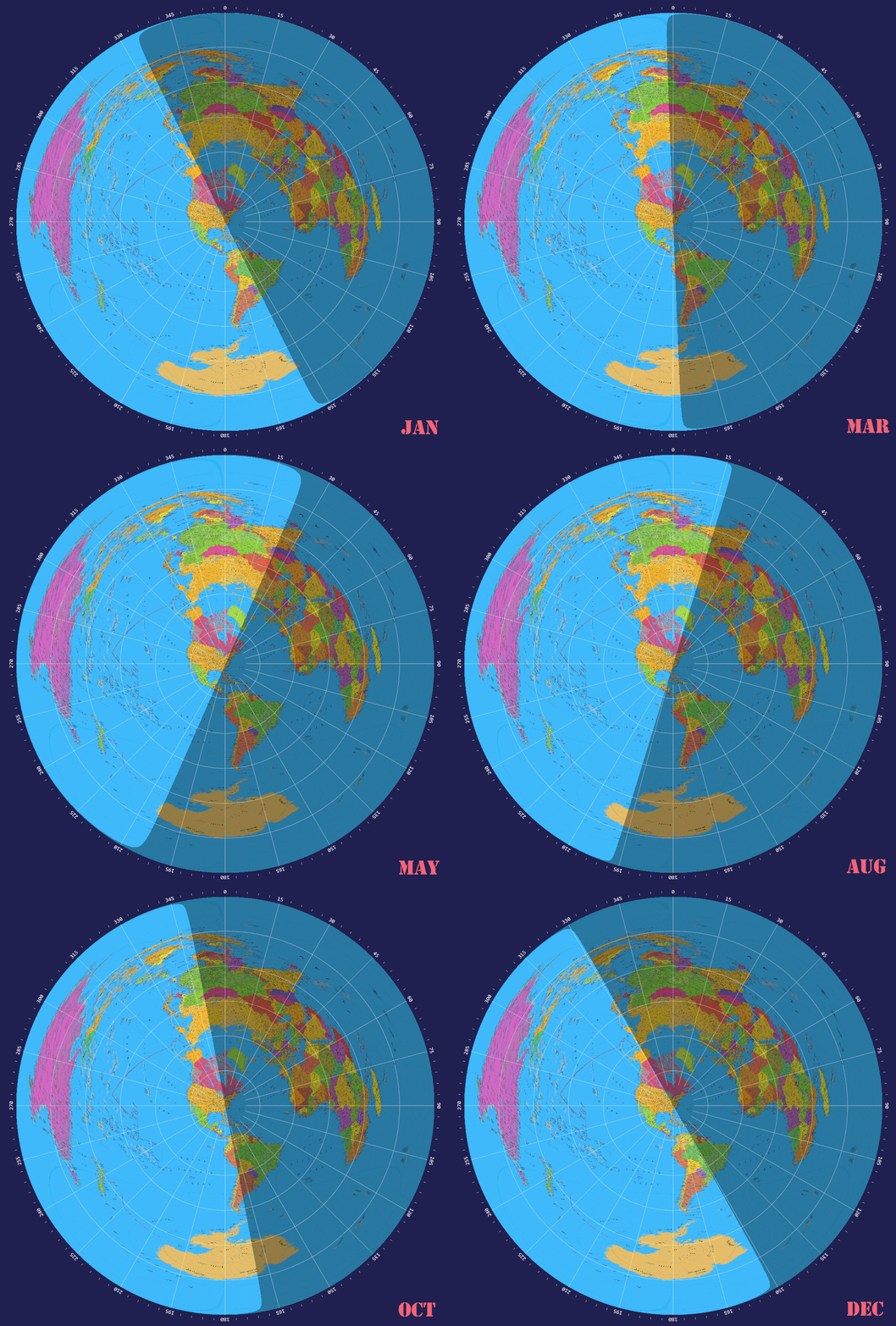
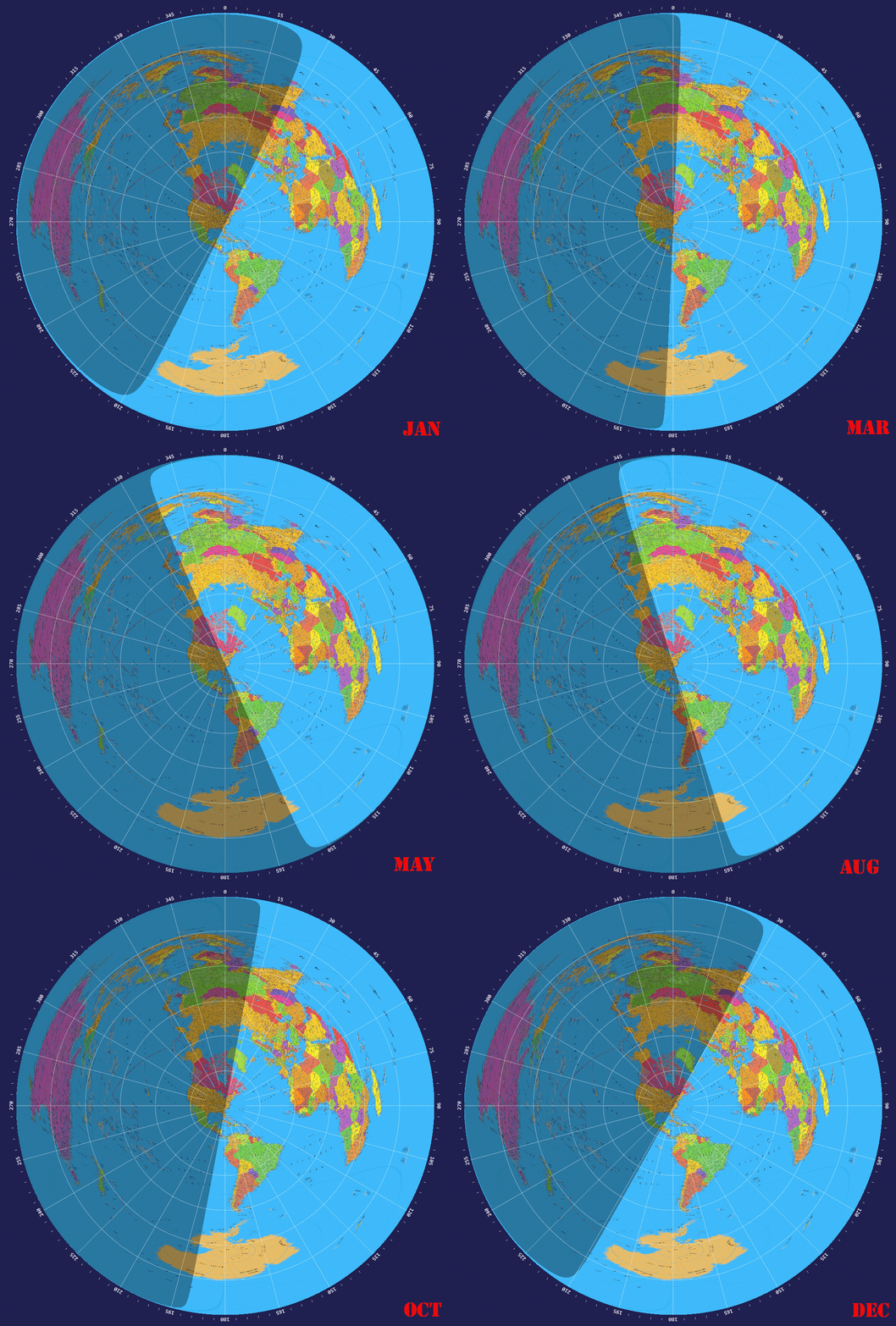
Click on the images to enlarge
Equirectangular Projections
A conventional world-map projection used to visualize the terminator's path across global landmasses.
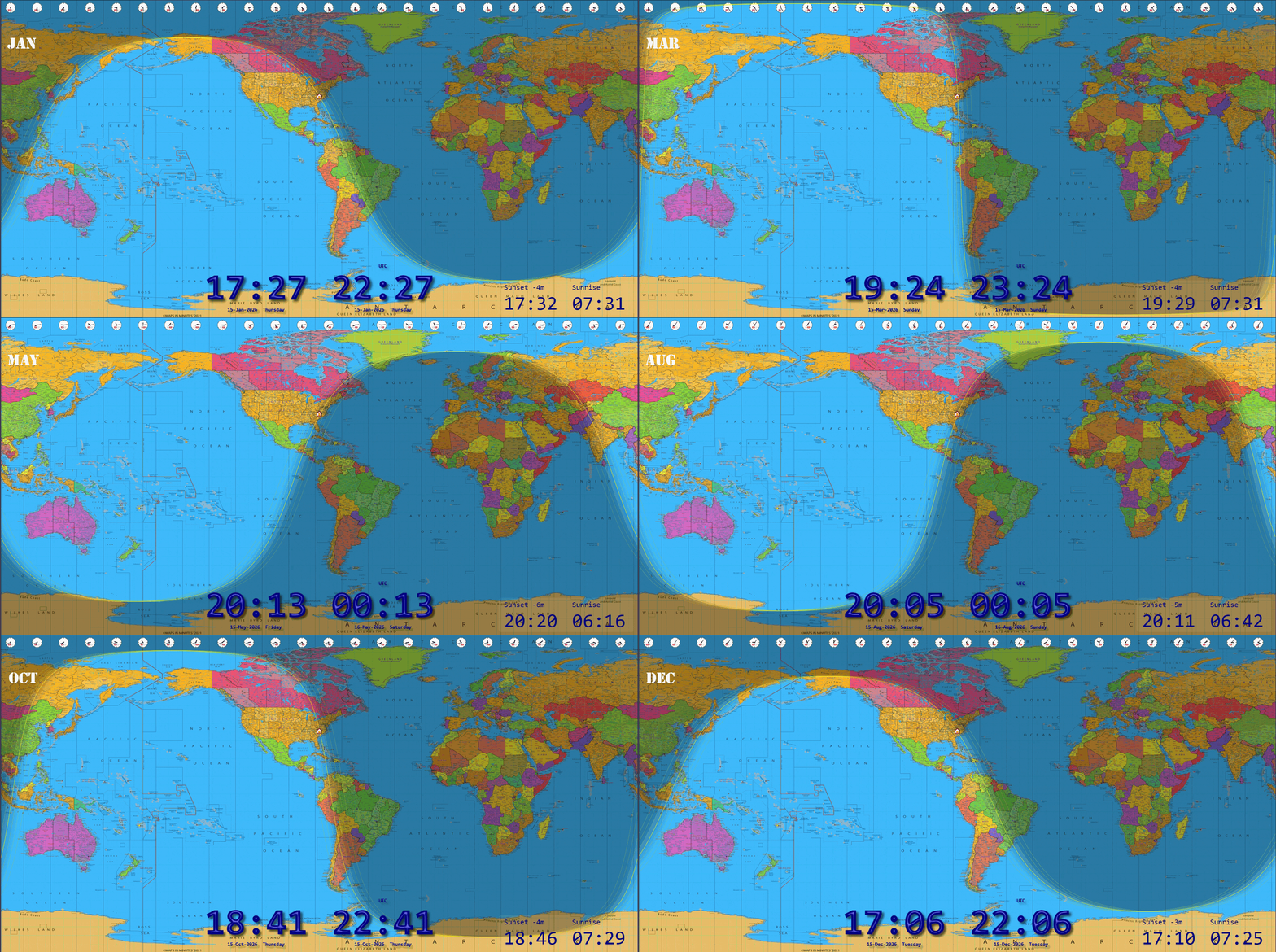
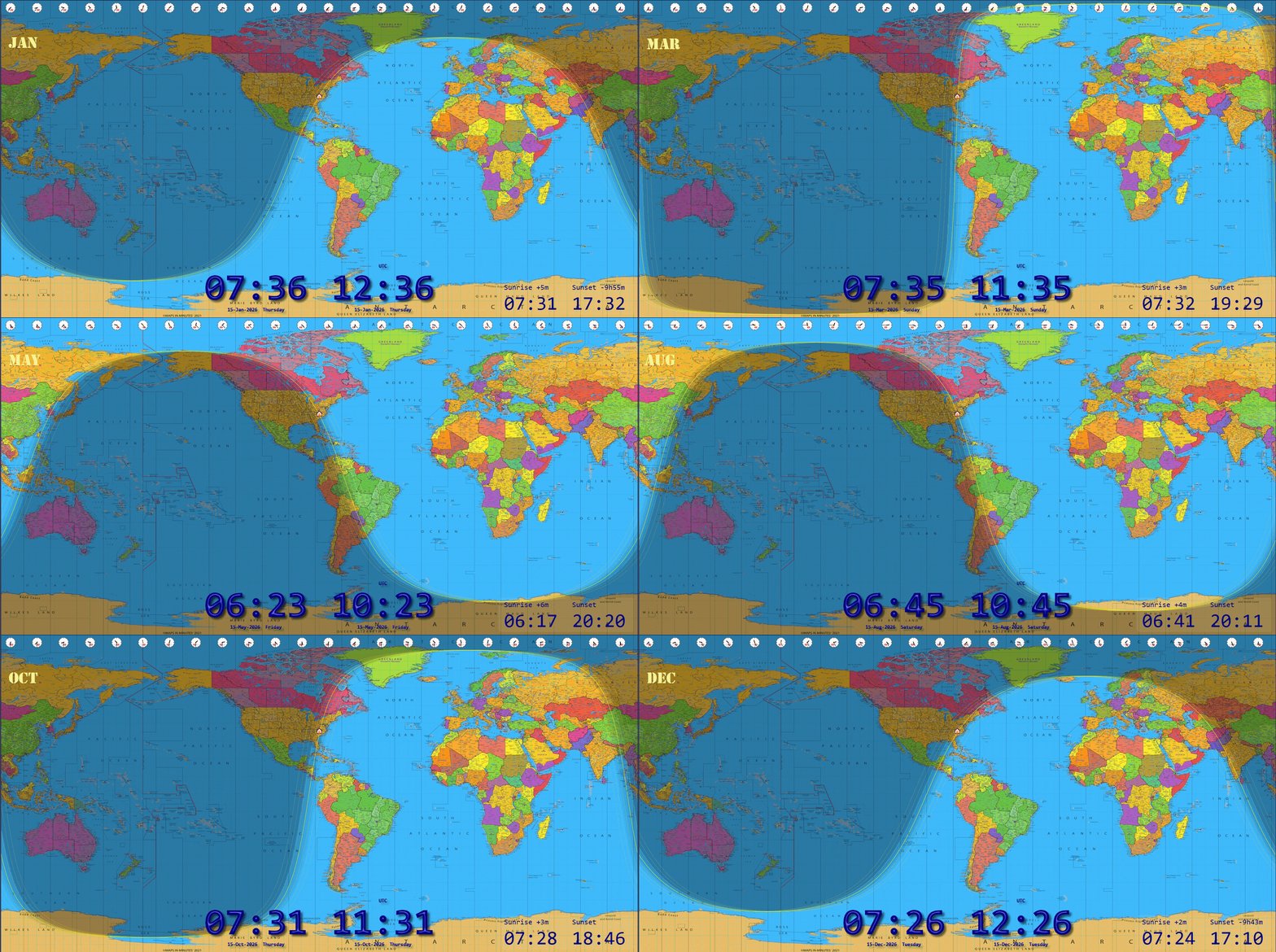
Click on images to enlarge
Regional DX Targets
By analyzing these geometric shifts, we can identify high-probability Grayline DX opportunities specific to North Carolina. The following PDF provides a month-by-month summary of these windows, organized by target region and heading.
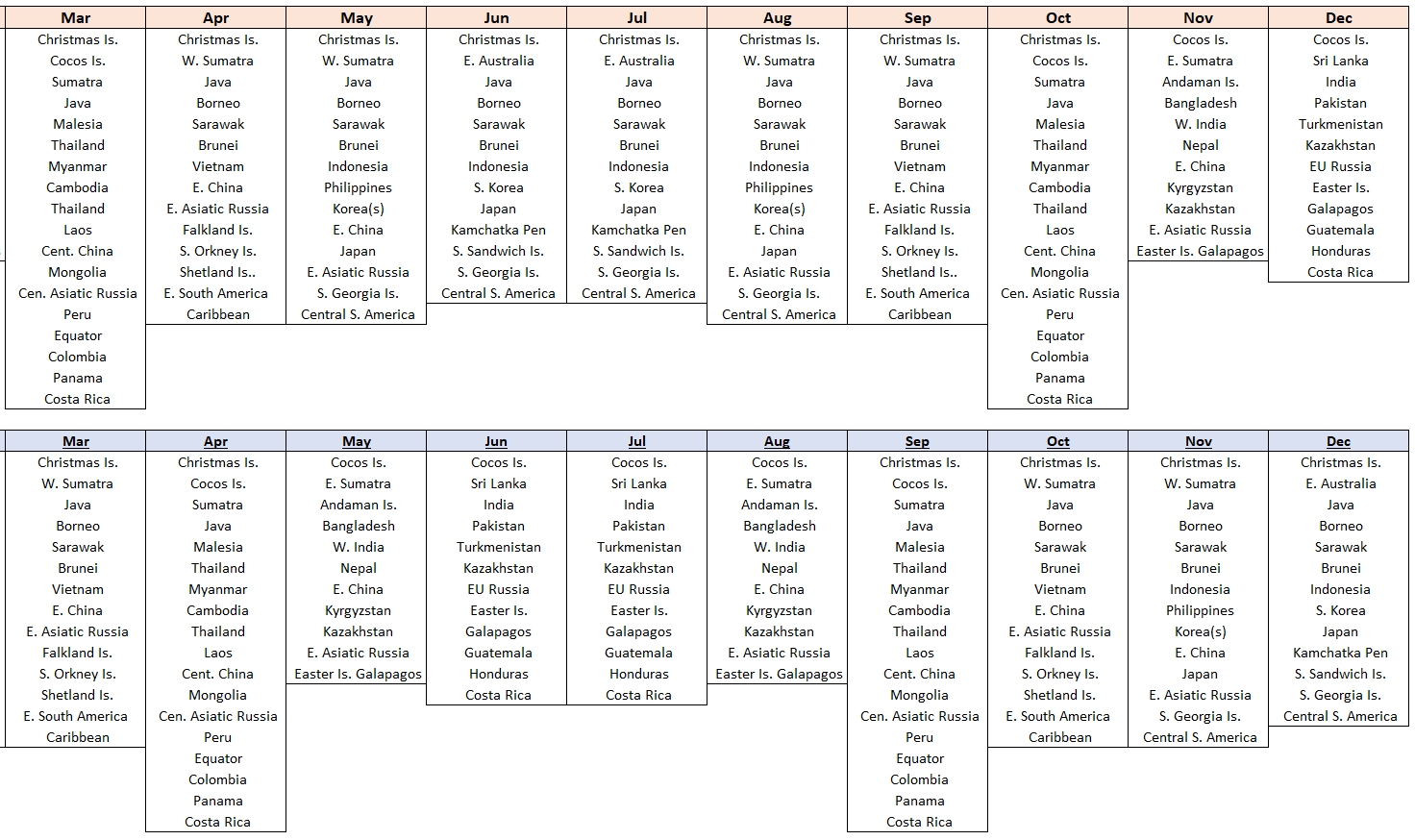
Click to download
Final Thoughts: The Challenge—and the Reward
In the end, evaluating a gray‑line path follows the same principles as assessing any HF route. An opening exists only if two conditions are met: the MUF must be sufficient for the path, and the signal must be strong enough to make the trip. These two factors are inseparable—each depends on the other. Without both working in your favor, long‑distance propagation simply won’t happen.
Long path DX on the low bands is rare because so many factors must align: low noise, brief openings, favorable MUFs, minimal absorption, and capable stations on both ends. But for operators who persist and time their efforts well, the gray line can deliver some of the most memorable and exotic contacts in amateur radio. These openings may not happen every day, but they do occur reliably within the timeframes described, and when they happen - it is magic!
D Region
– The lowest portion of the ionosphere, sitting roughly 45 miles above Earth. It is the main source of absorption on the low‑frequency bands, with its dampening effect strongest during daylight when solar radiation energizes it.
E Region – The first ionospheric layer capable of bending HF signals. Its influence is generally limited to the higher end of the HF spectrum.
F Region – The primary engine of long‑distance HF propagation. This layer refracts signals over great distances. In daylight it splits into two layers, F1 and F2, with the F2 layer serving as the key reflector for most long‑haul DX on the upper HF bands.
Gray Line – The moving boundary between night and day, often called the terminator or twilight zone. Stations located along this line benefit from unusually strong MF and HF propagation.
Long Path – The longer of the two great‑circle routes between stations. When both ends of the circuit lie in darkness and the long path crosses the nighttime side of Earth, it can support communication even when the shorter, more direct path cannot.
MUF (Maximum Usable Frequency) – The highest frequency at which a specific radio path can reliably propagate at a given moment.
This article is reprinted with permission of the author, Christopher Krstanovic - AI2F.
About Author
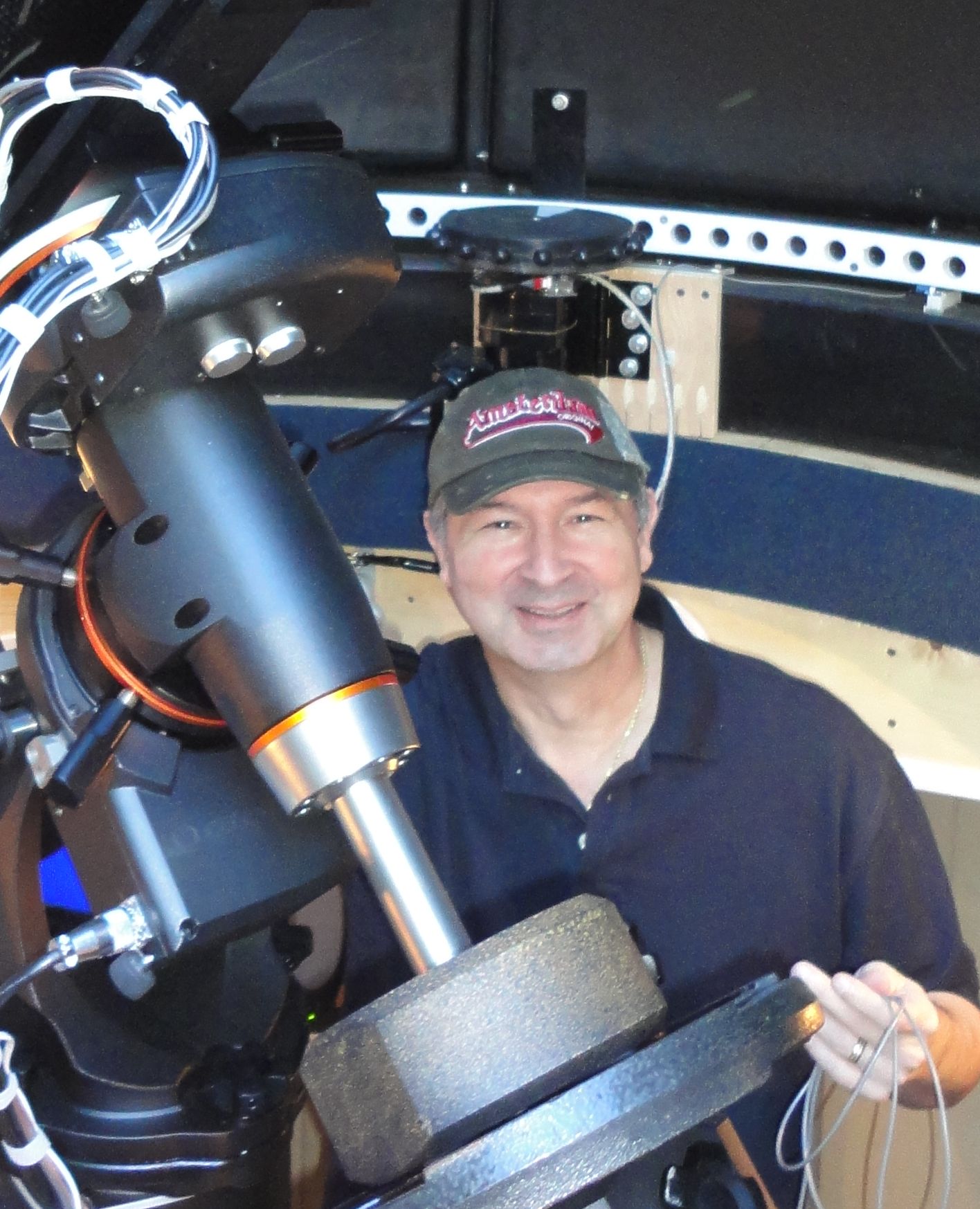 Christopher Krstanovic, AI2F, is a lifelong amateur radio operator, first licensed in the US in 1980s as WR1F. He holds degrees in Physics and a PhD in Electrical Engineering, and his career has spanned corporate engineering as well as technology entrepreneurship. After leaving corporate America, he founded and led three companies before returning to active amateur radio under his current call sign. His operating interests include HF, antenna design, practical radio engineering, Astronomy.