Cabarrus Amateur Radio Society

Cabarrus County, Concord, NC


The Ionosphere Made Simple
If you’ve ever wondered why some days HF feels like magic and other days it feels like punishment, the answer is almost always the same: the ionosphere. It’s this big, shimmering region way above us — roughly 50 to 400+ km up — where the Sun knocks electrons loose from atoms. And those free electrons are what make the HF work.

Free electrons interact with radio waves, and at HF they can bend them right back toward Earth instead of letting them escape into space.

Once you understand that, the whole HF experience starts to make a lot more sense.


The Layers: Think of Them as Personalities
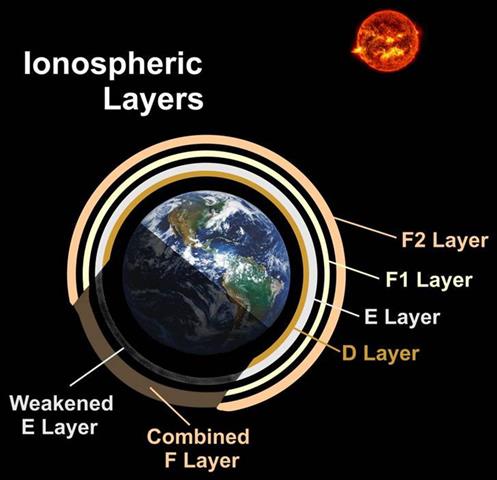
The ionosphere isn’t one big blob. It’s more like a cast of characters, each with its own quirks:
  • D layer: The daytime troublemaker. Loves to absorb your low-band signals.
  • E layer: Usually mild-mannered, but occasionally throws a wild Sporadic E party.
  • F layer: The grown-up in the room — especially F2. This is the layer that gives you the long-haul DX.


These layers change constantly with time of day, season, solar cycle, and geomagnetic activity. It’s like working with a coworker whose mood depends on the weather, caffeine level, and whether Mercury is in retrograde.

Critical Frequency: The Straight Up Limit
The critical frequency is simply the highest frequency that will bounce straight back down if you transmit vertically. For the F2 layer, we call it foF2.

If you shoot a signal straight up and it comes back, you’re below foF2. If it sails off into space, you’re above it. More electrons mean a higher foF2.

But here’s the thing: almost nobody operates straight up.

MUF: The Frequency That Actually Matters to You
The Maximum Usable Frequency (MUF) is the highest frequency that will support a path between your station and their station. It depends on:
  • Electron density
  • Layer height
  • Distance
  • Takeoff angle (thus higher your antenna, the better)

Because oblique paths travel through more ionosphere, MUF is always higher than foF2. Lower takeoff angles (longer distances) push it even higher.

This leads to the golden rule every seasoned operator knows:
operate just below the MUF. If MUF to Europe is 22 MHz, 15 meters should be hopping. Twelve might be sketchy. Ten could be glorious or silent depending on the angle.
Go above MUF and your signal just keeps on going… right into space.

LUF: The Basement
If MUF is the ceiling, LUF is the floor. Below LUF, the D layer "eats" your signal or the noise floor buries it.
  • 80 m is grumpy during the day
  • 40 m can be hit-or-miss at noon
  • 160 m is basically a nocturnal creature

Between LUF and MUF is your sweet spot. Below it: absorption. Above it: escape.

How the Layers Behave in Real Life
D Layer
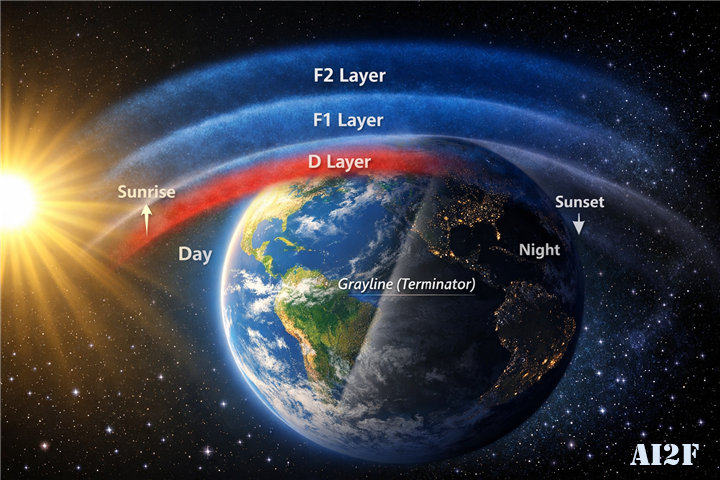
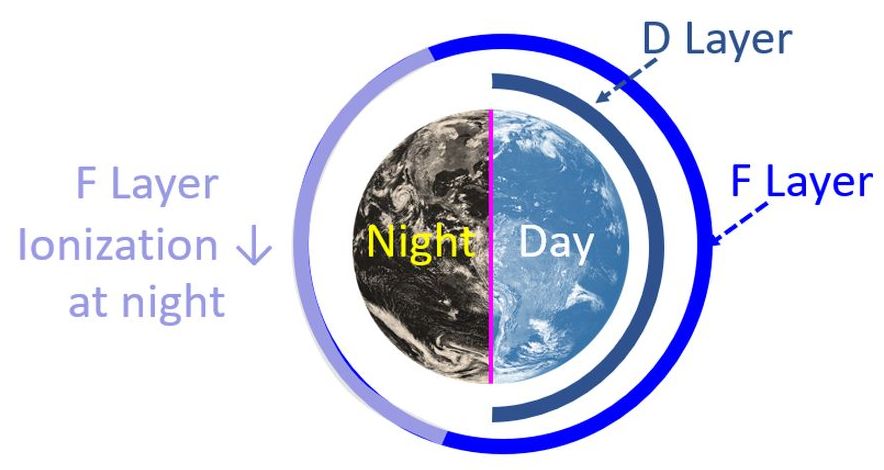
Only shows up during the day, and it’s hungry. It absorbs low HF like it’s at an all-you-can-eat buffet. Thankfully, it disappears quickly after sunset.

E Layer
Normally reflects up to about 10MHz. Great for short skip. But when Sporadic E shows up, all bets are off — suddenly 6 meters is alive and you’re working stations in countries you didn’t even know existed.

F Layer(s)
This is the long-haul engine. The F2 layer is the one that gives you those beautiful worldwide openings. It sticks around at night and responds strongly to the solar cycle.
When solar activity is high, F2 gets dense, MUF rises, and 10 meters becomes a playground again.


Solar Cycle: The Big Mood Swing

The 11 year solar cycle drives everything:
  • Electron density
  • foF2
  • MUF
  • Band openings
So:
  1. High solar flux? High MUF, great high-band DX.
  2. Low solar flux? Time to get cozy on 20, 40, and 80 meters.

The Solar Flux Index (SFI) is the quick indicator. Once it climbs above ~150–180, 10 meters starts waking up. Above 200, it’s a party.

Geomagnetic Activity: The Spoiler Alert
Solar flares and CMEs will ruin your day real fast:
  • D-layer absorption increases
  • Polar paths collapse
  • Signals fade, distort, or vanish

The K index tells you how bad things are. K = 0–2 is calm. K = 5+ means “go and do something else”

Grayline: The Magic Hour
Grayline propagation happens along the day/night boundary. At sunrise and sunset, the D layer disappears but the F layer is still very active. That’s a recipe for low-loss, long-distance paths. The snag is that both stations have to lie on the Grayline (the terminator).
Low-band DXers live for this moment - it is magic!

Skip Distance and Dead Zones
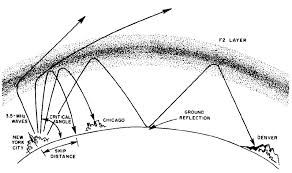
HF isn’t ground wave. There’s always a minimum distance before your first hop returns — the skip distance. Inside that radius is the dead zone.

This is why 20 m might reach Europe but skip right over your neighboring state.

NVIS solves this by using near-vertical angles on lower HF to fill in the close-in coverage.

Multi-Hop and Exotic Paths
Long-haul DX often involves multiple hops. Ground reflection matters — salt water is your friend.

Under normal conditions you can expect about 30db signal loss per hop – that is 5 s units. So having a lower angle antenna may save a hop, and voila, + 5 S-units.

Under excellent conditions (high MUF, low absorption, good reflection), signal loss per hop may be as low as 10-15db – about 2 S-units down.

Does the ground where hops happen matter? Absolutely!
  • Best hop efficiency: calm seawater
  • Worst hop efficiency: dry, rough land

You may also run into:
  • Trans-equatorial propagation
  • Long-path openings
  • Odd directional quirks during geomagnetic events

HF is full of surprises, and that’s half the fun. (I always wondered, what is the other half…?)

Operating Strategy
A smart operator:
  • Checks solar flux
  • Checks K index
  • Looks at MUF maps
  • Works just below MUF
  • Exploits Grayline
  • Uses low bands at night, high bands during day
  • Watches for Es on 6 m

And above all: listens first. The bands always tell the truth.

Modes and SNR
Weak-signal modes like FT8 and CW need far less SNR than SSB. That effectively lowers LUF and extends openings. A band that sounds dead on phone may be alive digitally.

Seasonal Effects
  • Winter favors low-band DX. In summer there is lot of QRN, created by distant lightning discharges,
  • Summer favors sporadic E
  • Equinoxes often give the best F2 propagation

HF propagation isn’t magic — though it sure feels like it when 10 meters suddenly lights up. It’s all driven by solar radiation, plasma physics, and geomagnetic behavior. Once you understand how foF2, MUF, LUF, and the ionospheric layers interact, the bands stop being mysterious. You can look at the numbers, glance at the clock, and have a pretty good idea of what’s open.

And when the solar cycle peaks and 10 meters sounds like a worldwide party again, it’s hard not to smile knowing your little wire antenna is riding a river of electrons across the planet.

That’s HF. That’s why we love it.


Putting It All Together: A Practical Cheat Sheet

• For long-distance DX:
Watch the MUF along your path. Higher MUF opens higher, quieter HF bands.

• For local and regional nets:
Track foF2. If your operating frequency is below foF2, NVIS is likely.

• For low-band performance:
Understand D-layer absorption. Daytime suppresses low-band DX; nighttime restores it.

• For the “magic” contact:
Operate near sunrise or sunset and exploit the Gray Line for low-loss, low-noise paths.

Propagation isn’t random. When the bands behave strangely, the ionosphere is usually doing something logical—you just need the right lens to see it.


This article is reprinted with permission of the author, Christopher Krstanovic - AI2F.
About Author
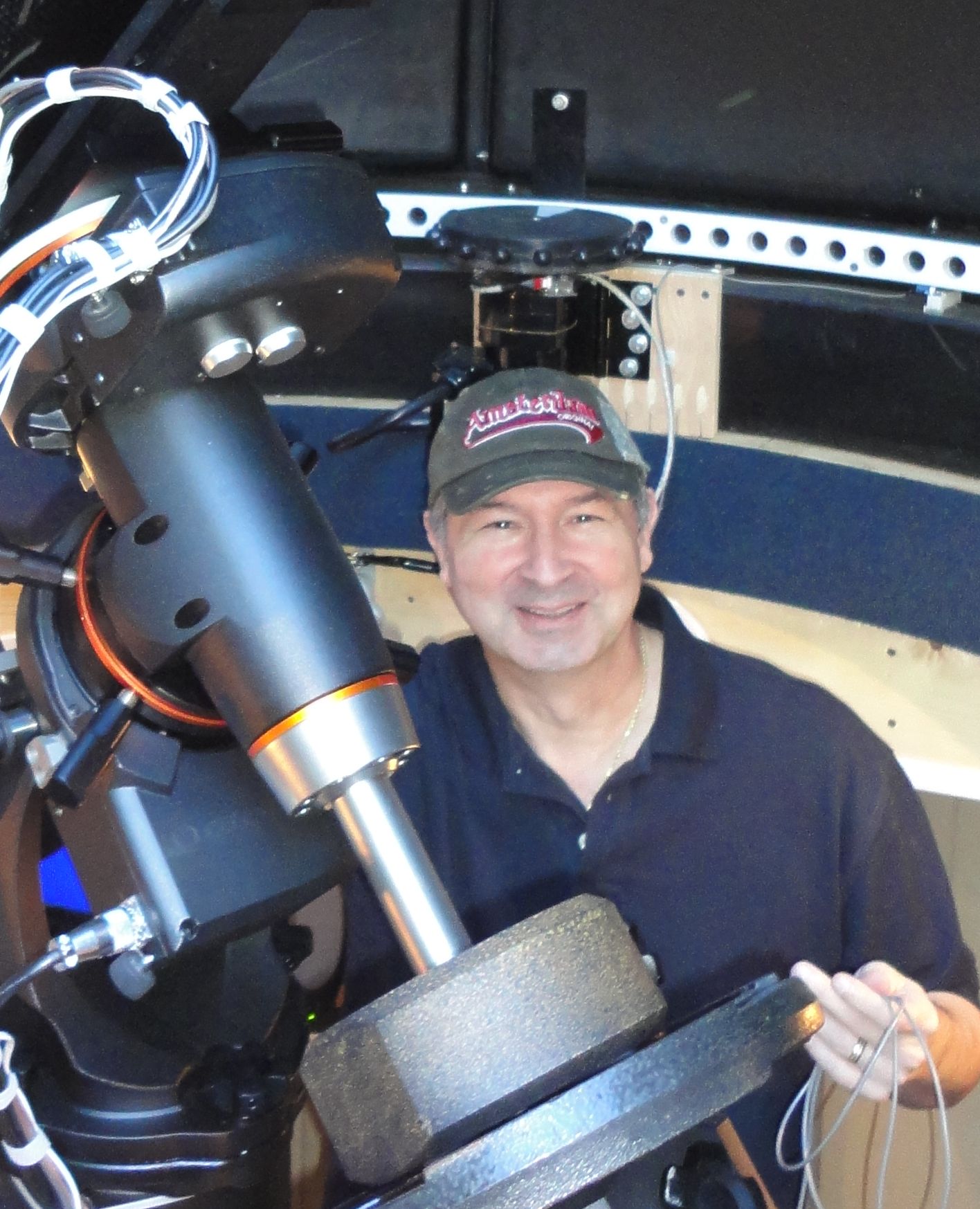
Christopher Krstanovic, AI2F, is a lifelong amateur radio operator, first licensed in the US in 1980s as WR1F. He holds degrees in Physics and a PhD in Electrical Engineering, and his career has spanned corporate engineering as well as technology entrepreneurship. After leaving corporate America, he founded and led three companies before returning to active amateur radio under his current call sign. His operating interests include HF, antenna design, practical radio engineering, Astronomy.

Copyright 2026 © Cabarrus Amateur Radio Society. All Rights Reserved.