The Secret Ham Army
The Secret Wartime History of the Voluntary Interceptors
In the late 1970s, over cups of tea and plates of crumpets in a quiet Midlands English living room, two elderly radio amateurs entrusted me with a secret. They were veterans of the Voluntary Interceptors, a shadow network of wartime hams who quietly spent their nights hunting enemy Morse signals from their own homes.
That encounter sparked a lifelong fascination with one of the greatest untold chapters of wireless history.
This article brings their stories into the light, tracing how ordinary hobbyists became a vital component of Allied intelligence.
More than just a retrospective, it is a testament to the enduring value of the amateur spirit—showing that the classic skills of signal hunting and independent problem-solving are just as critical to modern emergency communications today as they were eighty years ago.
I first learned about Britain's wartime Voluntary Interceptors (VIs) while studying for my engineering degree in Coventry, England, during the late 1970s. At the time, I was a young radio amateur, utterly captivated by Morse code, shortwave listening, antennas, and the rich lore of wireless communication.
The story came to me in the best possible way: not from a history book, but straight from the people who had lived it.
An older ham I knew through his son, "Bruce", had been a vital cog in the Voluntary Interceptor organization during the Second World War. Like many veterans of that shadow war, he spoke of it sparingly. Even decades later, the deeply ingrained habit of wartime discretion remained. Yet, over countless cups of tea and the crumpets his wife loved to make, our conversations inevitably always drifted to radio. Bit by bit, his wartime experiences emerged.
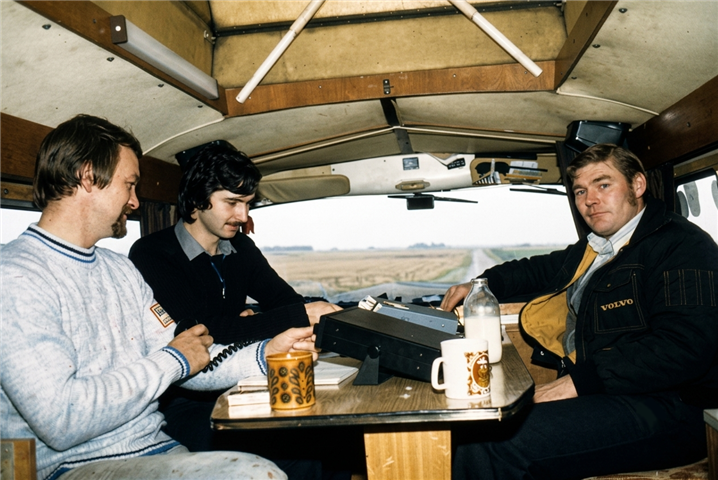
Bruce, The Whisky Man and myself (the youngest) working DX - circa 1979
Through him, I was introduced to another former VI, then living in Birmingham. This gentleman had served as an over-the-air interceptor before moving up into the senior ranks of H.M. Radio Service. He provided the missing macro-view, explaining exactly how this civilian listening network integrated into Britain's grand strategy. Like my first friend, he had been a licensed amateur before the code keys of war were tapped, swept up into one of the most secretive intelligence operations in British history.
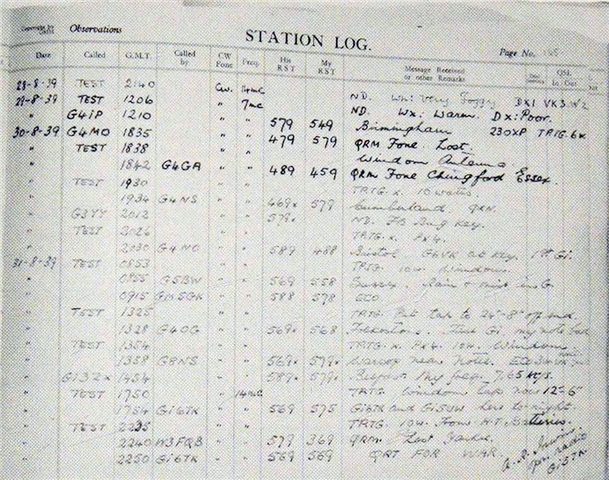
Ham Wartime Log Sign-off
Nearly fifty years have slipped by since those afternoons. Time has taken its toll on my memory, and I can no longer recall their names or their callsigns, and I have lost touch with their families. I regret that deeply. Both men deserved to have their names recorded in the logbook of history. The memories they entrusted to a curious young foreign ham sparked a lifelong fascination that never left me.
For decades, the VIs remained a captivating footnote in my mind. Then, recently, I decided to pull that signal out of the noise. I spent the last months digging through archives, books, and the historical records that have grudgingly emerged from behind the declassification curtain.
What I discovered vindicated everything those two old-timers told me. The Voluntary Interceptors were not a casual wartime curiosity or some hair brain idea brits had. They were the frontline ears of Britain’s intelligence apparatus—the ultimate proof-of-concept of the technical brilliance hidden within the amateur radio community.
The Missing Link of Bletchley Park
Today, Bletchley Park is a household name. The world celebrates Alan Turing and the brilliant codebreakers who shattered the German Enigma ciphers. Their achievements are legendary. Yet a fundamental truth is often overlooked:
No cryptanalyst can decode a message that hasn’t been intercepted.
Before a German transmission could be deciphered, someone had to pull it out of the ether.
In the tense run-up to World War II, British intelligence panicked. Nazi Germany was expanding, and London feared an invisible army of domestic spies and saboteurs transmitting blueprints and invasion plans back to Berlin.
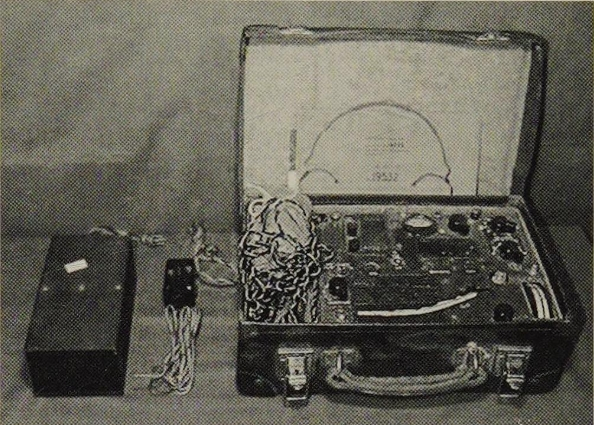
Clandestine WWII German Suitcase Radio
To hunt these clandestine signals down, the government needed elite radio operators. But the military didn't have them. Standard military signaling schools took months to train basic operators, and the impending war wouldn't wait.
Fortunately, Britain possessed a ready-made, nationwide network of obsessives who spent their nights doing exactly what the government required: hunting weak signals on the shortwave bands and copying rapid-fire Morse code.
They were radio amateurs. Hams.
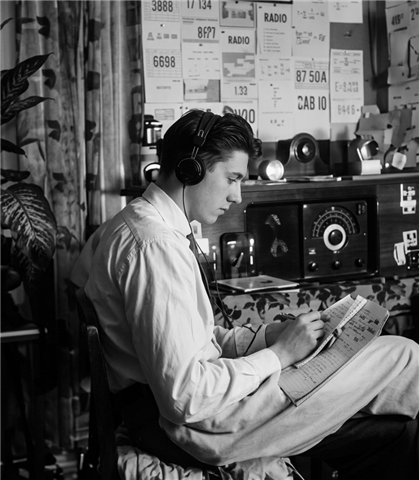
VI Bob Barr (Pre War picture, enhanced)
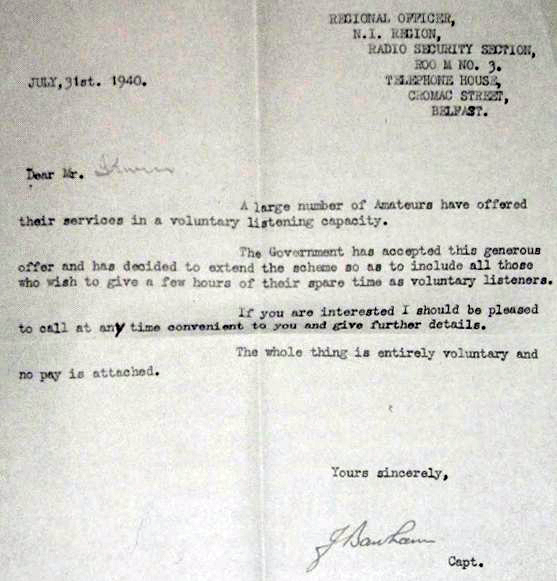
The Radio Society of Great Britain (RSGB), a British counterpart to our own ARRL, stepped up to the plate, quietly vetting and recruiting its members. Top-tier operators underwent rigorous background checks and were sworn to total secrecy under the Official Secrets Act. Most had no idea what they were actually signing up for; they only knew their country needed their stations.
Thousands volunteered. The Voluntary Interceptors were born.
Attics, Basements, and Homebrew Shacks
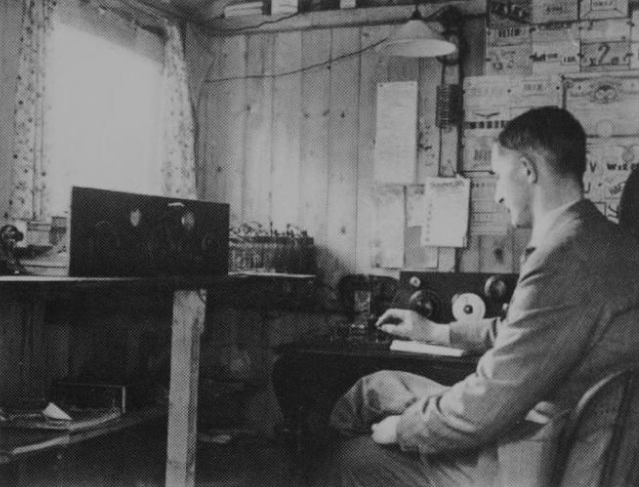
Unlike military operators deployed to highly visible, centralized listening posts, the VIs stayed home. They went to work, tended their gardens, lived ordinary civilian lives, and fought the war behind closed doors.
Their battle stations were spare bedrooms, dusty attics, damp basements, and backyard sheds. These spaces were packed with “high-end” communication receivers—like the legendary National HRO or Eddystone models—alongside homebrew power supplies, glowing vacuum tubes, and stacks of logbooks.
To their neighbors, they were just eccentric hobbyists playing with wires in the trees. In reality, they formed one of the most effective, decentralized SIGINT (signals intelligence) networks ever devised.
The military quickly realized that amateurs possessed a definitive edge over standard service operators. Hams inherently understood RF propagation. They knew the quirks of the ionosphere, how to ride the RF gain, and how to track down drifting frequencies.
But, more importantly, they were masters of the weak signal.
A military operator was trained to copy loud, stable tactical networks. Amateurs, however, had spent years training their brains to copy Morse code buried deep beneath standard HF misery: QRN (static crashes), QRM (man-made interference), and rapid QSB (fading). Where a military recruit heard only a wall of noise, a ham heard copyable code.
A Night on the Watch
To understand the sheer grit of a VI, you have to imagine a winter night in 1941.
After a full day at his civilian job, an operator sits down in a freezing attic shack. He slips on a pair of heavy, high-impedance headphones and slowly sweeps his receiver across assigned sectors of the high-frequency spectrum.
Hours pass in mind-numbing monotony. The bands are a wash of atmospheric roar. Then, a faint, rhythmic pulsing appears—a whisper of CW just a fraction of an S-unit above the noise level.
The operator's fingers fly to his pen. Accuracy is absolute.
The VIs didn't decode the messages. What they copied were meaningless, five-character encrypted cipher groups. A single missed dit or misplaced dah wouldn't just corrupt a word; it could break the chain of an entire cryptanalytic breakthrough.
The mandate was brutal: Hear everything, record everything, misinterpret nothing.
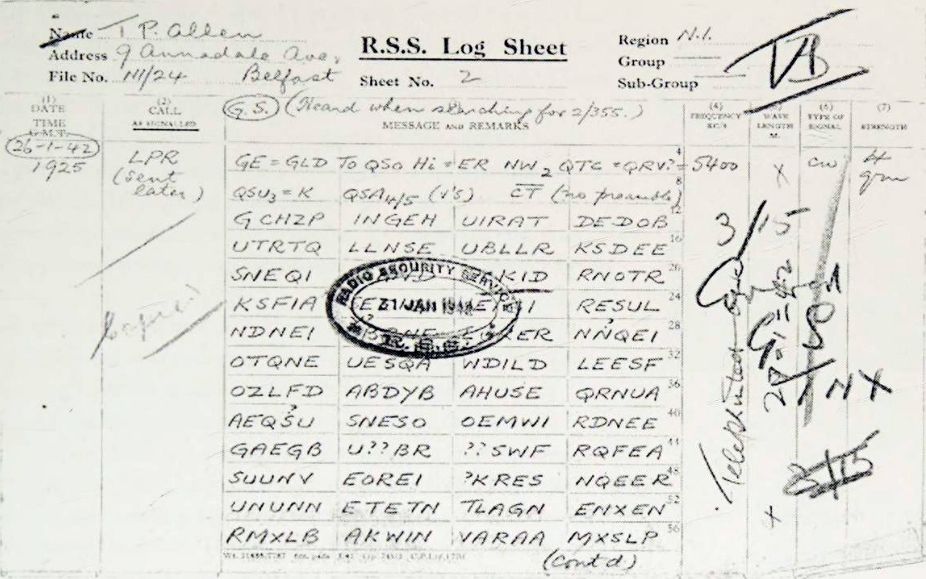
Despite roaring thunderstorms obliterating whole strings of characters, or intentional German jamming, they pushed through. Night after night.
The Glass and Steel of the VI Shack: Classic Intercept Rigs
When the war began, the British government lacked the manufacturing capacity to supply thousands of volunteers with professional communications receivers. The solution? The VIs initially fought the war using whatever they already had on their workbenches. This created a fascinating mix of high-end commercial American imports, rugged domestic British engineering, and pure ham ingenuity.
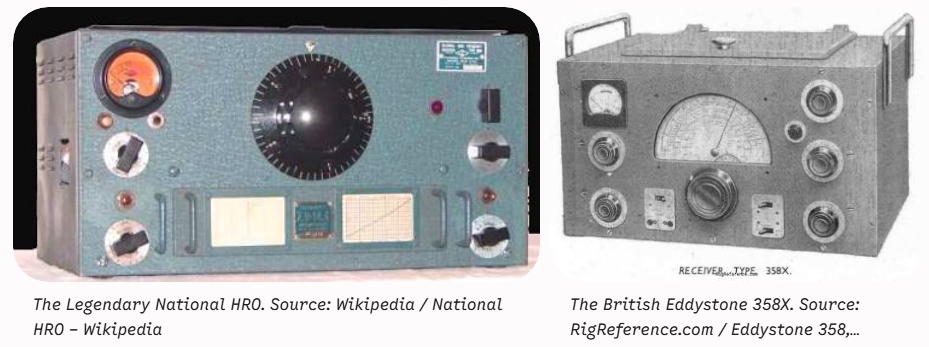
The National HRO (USA): To a VI, the American-made National HRO was the absolute gold standard. It was famous for its distinctive, oversized central micrometer dial, which allowed for unparalleled reset accuracy. Instead of a bandswitch, it used heavy, slide-in plug-in coil packs. For hunting stable, drifting Abwehr transmitters on HF, nothing matched its rock-solid stability and razor-sharp crystal filter. The British government eventually imported these via Lend-Lease in massive quantities specifically for the Y Service.
The Eddystone 358X (UK): Built in Birmingham by Stratton & Co., this became the ubiquitous British-made intercept weapon. It was an 8-valve superheterodyne powerhouse that utilized a similar plug-in coil system to the HRO, covering 90 kHz to 31 MHz. Encased in a massive, ripple-finish steel cabinet, it was designed to survive under-fire military environments but found its true home on civilian desks, providing incredible image rejection and weak-signal clarity.
Homebrew TRF and Superhets: Many resource-poor hams constructed their own intercept receivers. Using whatever spare parts, variable capacitors, and octal-base vacuum tubes they could find, they built highly optimized 3-valve and 4-valve Tuned Radio Frequency (TRF) regenerative receivers. What these homebrew rigs lacked in dynamic range, the hams made up for with pure operating skill—balancing the receiver on the absolute knife-edge of oscillation to copy weak CW through the QRM.
The Ultimate Spatial Diversity Array
The geographical distribution of these amateur shacks was a stroke of engineering genius.
As any HF operator knows, propagation is unpredictable. A signal completely skipped over London might be booming into Manchester. A frequency wiped out by local noise in Scotland might be crystal clear to a ham in Wales.
By scattering thousands of listeners across the British Isles, the network achieved incredible spatial diversity. If a German agent altered his power or antenna orientation, someone, somewhere in the UK, would still have him in their skip zone.
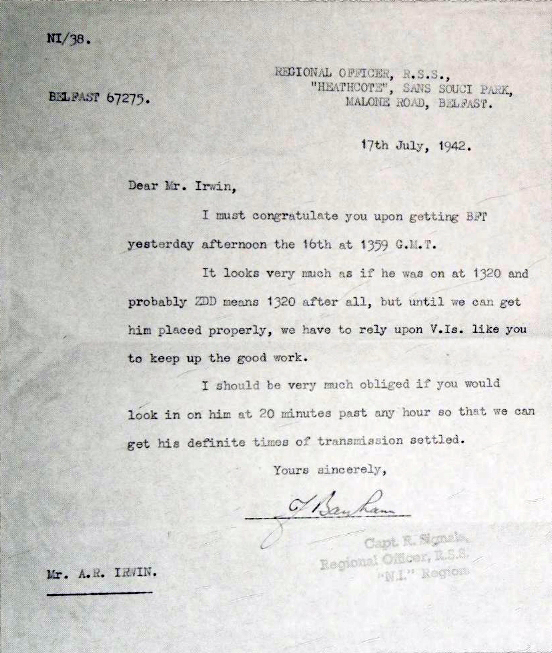
This setup also provided automated quality control. When multiple VIs logged the same transmission, Bletchley Park analysts compared the logs, cross-referencing them to fill in blanks caused by local fades.
Better yet for a wartime economy: the network was essentially free. The volunteers used their own gear, maintained their own antennas, and burned their own electricity. Britain had successfully crowdsourced a world-class intelligence network.
Tracking the Abwehr
Initially tasked with catching domestic spies, the VIs soon ran out of targets. MI5’s "Double Cross System" had successfully captured or turned virtually every German agent inside the country.
But the VIs weren't shut down. Instead, they re-tuned their dials.
Amateurs began intercepting vast, international radio networks run by the Abwehr—Germany’s military intelligence service. These stations were transmitting from occupied Europe, North Africa, and South America.
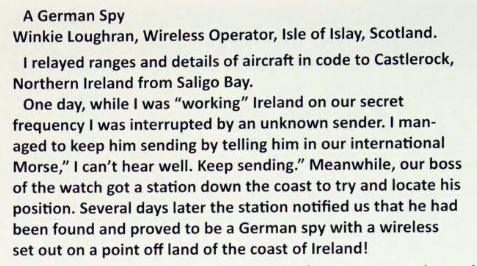
The volume of traffic exploded. Millions of words of raw cipher data were logged by VIs, bundled up, and sent to Bletchley Park via the postal service or motorcycle couriers. This data became the backbone of the "Y Service."
The relationship was a production line: the VIs supplied the raw spectrum harvest, and Bletchley Park manufactured the actionable intelligence. Neither could have succeeded without the other.
VI Antennas and the Neighbor Problem (WW2 HOA Equivalent)
An elite shortwave receiver is completely deaf without a proper skywire. For the Voluntary Interceptor, however, deploying an effective High-Frequency (HF) antenna array was a dangerous game. Erecting a massive, multi-element directional array or a highly visible longwire was a surefire way to trigger suspicion from neighbors convinced there was a "Fifth Column" Nazi spy living on the block.
To survive the watch, VIs became masters of covert RF engineering:
The Stealth Longwire: The standard weapon of choice was an end-fed random wire antenna. Instead of heavy gauge copper, VIs used incredibly thin 24 AWG or 26 AWG enameled copper wire. They would launch these thin lines out of an attic window to a distant tree or garden shed under the cover of darkness. To the casual observer on the ground, the wire was completely invisible against the sky, yet it provided excellent multi-band performance for pulling in signals from across Europe.
Attic Dipoles and Loops: Many operators confined their antennas entirely indoors to avoid detection. They ran full-sized horizontal dipoles along the rafters of their attics. While attic roofing tiles caused some attenuation, the elevation gain of a two- or three-story home provided a favorable take-off angle for European shortwave skip. Large, multi-turn tuned loop antennas were also hidden in spare bedrooms; these provided excellent directional nulling capabilities to cut out local power-line noise and zero in on weak signals.
The Open-Wire Feedline: To keep feedline losses minimal while routing RF from the attic down to a basement workshop or bedroom shack, hams avoided heavy commercial lines. Instead, they fabricated custom open-wire feedlines using wooden spacers (often made from boiling wooden clothes pegs in paraffin wax to insulate them from moisture). This high-impedance line kept the signal intact right to the antenna tuner, ensuring every microvolt of captured German Morse code made it to the receiver grids.
The Unsung Operators
What makes the VI story truly unique is its complete lack of military hierarchy. Because the only metric that mattered was a razor-sharp ear for CW, the standard barriers of age, class, and physical ability disappeared.
School-aged teenagers operated alongside retired bank managers. Engineers traded notes with store clerks. Disabled individuals who couldn't pass a military physical found themselves handling top-secret data.

Many paid a social price for their silence. Neighbors whispered, wondering why these able-bodied men weren't in uniform or why they spent their nights huddled over strange, glowing apparatuses. The VIs took the suspicion on the chin. They had signed the Official Secrets Act, and they took that oath to their graves – well, at least until I came along.
A Legacy Worth Remembering
When the war ended, there were no medals or victory parades for the VIs. The network was dismantled, gear was packed away, logs were burned, and files were deep-freezed in government archives. The silent army simply went back to their day jobs and civilian clubs.
Nearly fifty years have passed since I sat in those English living rooms, listening to two old hams reminisce over tea. The modern amateur radio landscape looks vastly different now, dominated by microprocessors, digital modes, and global internet links.
Yet the story of the Voluntary Interceptors carries an enduring lesson for us today.
Amateur radio has never been just a hobby. It is a deep reserve of national infrastructure, technical self-reliance, and cognitive skill. The VIs didn't learn to pull signals from the mud via a military manual; they learned it through late-night experimentation, building their own gear, and chasing DX.
The technologies change, but the fundamentals do not. The Voluntary Interceptors worked in absolute silence, but their legacy still echoes through every signal we pull from the noise today.
For us, radio amateurs, their story represents one of the finest examples of what our hobby can accomplish when technical knowledge, dedication, and public service come together.
The Voluntary Interceptors may have worked in silence, but their contribution echoes through history.
It and they deserve to be remembered.
This article is reprinted with permission of the author, Christopher Krstanovic - AI2F.
About Author
 Christopher Krstanovic, AI2F, is a lifelong amateur radio operator, first licensed in the US in 1980s as WR1F. He holds degrees in Physics and a PhD in Electrical Engineering, and his career has spanned corporate engineering as well as technology entrepreneurship. After leaving corporate America, he founded and led three companies before returning to active amateur radio under his current call sign. His operating interests include HF, antenna design, practical radio engineering and Astronomy.