Cabarrus Amateur Radio Society

Cabarrus County, Concord, NC


Why the Bands Do What They Do
A Practical Guide to MUF, foF2, the D Layer, and Gray Line Propagation
If you’ve spent any time on HF, you’ve probably experienced this mystery: a band sounds completely dead, you step away for coffee, and when you come back an hour later it’s suddenly alive with DX. Or a local net that’s rock-solid one evening simply vanishes the next.

What’s happening isn’t magic—it’s the ionosphere.


High-frequency radio communication depends on a constantly shifting ionosphere shaped by solar radiation, geomagnetic activity, and the daily cycle of light and darkness. These forces determine whether a band is open, noisy, or seemingly unusable, and they influence everything from local NVIS coverage to long-distance DX.

By understanding how solar energy alters the ionospheric layers—and how those changes show up in key propagation metrics like MUF and foF2—you can make much better sense of what you’re hearing (or not hearing) on the bands.


For amateur radio operators, the ionosphere is both a gateway and a gatekeeper. It bends, absorbs, or ignores your signal depending on solar radiation, time of day, season, and geomagnetic conditions. To understand why a band is wide open one hour and stone dead the next, you need to understand four key elements of HF propagation:
  • Maximum Usable Frequency (MUF)
  • Critical Frequency (foF2)
  • The often-overlooked D-Layer
  • The powerful effects of the Gray Line

(Throughout this article, QRN refers to natural noise—storms, lightning, and solar effects—not man-made interference, which we’d call QRM.)

MUF: The Gateway to Long-Distance DXs
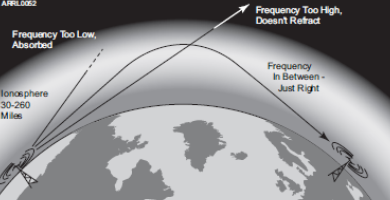
The Maximum Usable Frequency (MUF) is the highest frequency that can support ionospheric refraction between two points on Earth. By convention, MUF is usually calculated for a 3,000 km path—often labeled MUF(3000) in propagation tools—but the same principles apply to any HF circuit.


The Go / No-Go Gauge
If the MUF along your path is 24 MHz, the 15-meter band (21 MHz) should be open, while 12 meters (24.9 MHz) and above will overshoot the ionosphere entirely. In practical terms, MUF tells you which bands are in play for DX at a given moment.

The Weakest Link
Long, multi-hop paths depend on the lowest MUF anywhere along the route. If even one hop can’t refract your signal, the entire path collapses. This is why marginal openings can fade suddenly—even though conditions seem unchanged at your location.

Angle Matters
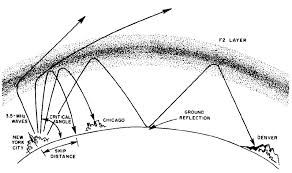
MUF is strongly tied to takeoff angle. Long paths use low-angle radiation and can support higher frequencies. Shorter paths rely on steeper angles, which are limited by the ionosphere’s critical frequency rather than MUF. This is why a band may support DX while nearby stations are completely absent.

MUF and Band Noise
Higher HF bands (15 through 10 meters) often sound quieter, not because MUF reduces noise, but because:
  • Atmospheric QRN is strongest at lower frequencies
  • Man-made noise couples less efficiently at higher frequencies

When MUF rises and the upper HF bands open, operators often notice how remarkably quiet these bands can sound compared to 80 or 40 meters.

foF2: The Key to Local and NVIS Contacts
While MUF describes long-distance paths, foF2 tells you what the ionosphere is doing directly above your station. It is the highest frequency that the F2 layer can refract straight back down at vertical incidence.


Indicator of Electron Density
A high foF2 value means a dense, well-ionized F2 layer. When foF2 rises above about 7 MHz, the 40-meter band can support NVIS (Near Vertical Incidence Skywave) propagation—ideal for local and regional coverage.

When the Band “Goes Long”
If foF2 drops below about 3 MHz, the F2 layer can no longer reliably return 80-meter signals at steep angles. Local stations disappear, and the band favors longer-distance, low-angle paths instead. This is the familiar experience of a once-busy band suddenly “going long.”

A Space Weather Baseline
Networks like GIRO, which collect ionosonde data worldwide, allow operators to track foF2 in near-real time. These tools are especially valuable for emergency communications planning and regional HF coordination.

foF2 and What You Hear
The F region does not generate noise, but it controls which noise reaches your receiver:
  • When foF2 is high, lower bands are open locally—and exposed to nearby QRN
  • When foF2 drops at night or during solar minimum, those same bands may lose local signals but reveal distant storms thousands of miles away

The D Layer: The Absorber That Shapes the Low Bands
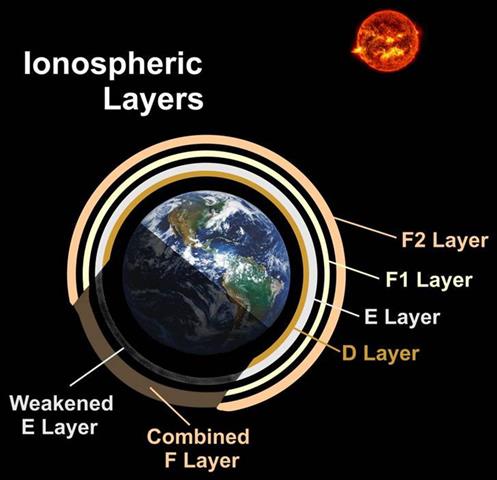
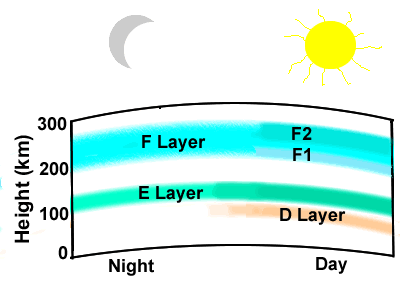
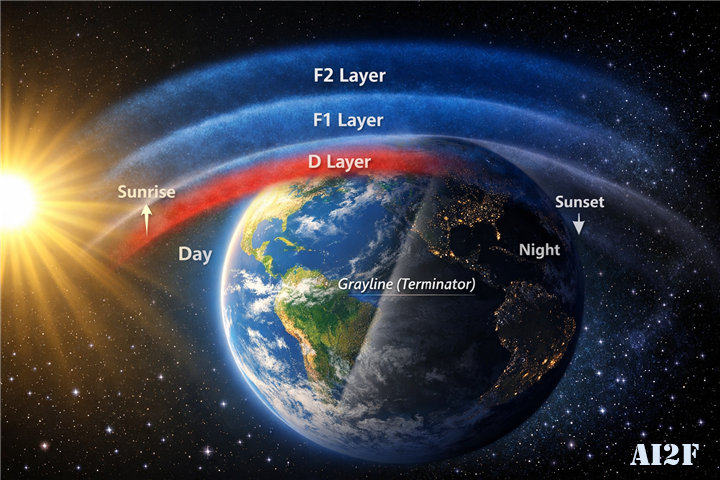
The D layer is the lowest ionospheric region. It forms during daylight under solar radiation and disappears rapidly after sunset. Unlike the F layers, the D layer does not refract HF signals—it absorbs them.

Daytime Absorption
On 160, 80, and 40 meters, the D layer acts like a wet blanket. Signals passing through it lose strength—sometimes dramatically. This is why daytime low-band operation is typically short-range and inefficient for DX.

Nighttime Relief
After sunset, the D layer collapses within minutes. Absorption drops sharply, allowing lower bands to open for long-distance work.

Why the Low Bands Sound Noisy
Daytime low-band “noise” is mostly a signal-to-noise problem:
  • The D layer weakens desired signals
  • Local atmospheric QRN remains strong
  • The result is poor readability, not necessarily more absolute noise

At night, when absorption disappears, the bands become more sensitive—and suddenly you can hear storms and signals from far beyond your local area.

In short:
  • Daytime: No DX, poor SNR
  • Nighttime: More DX, often more distant QRN—but much better signal strength

The Gray Line: The Propagation Sweet Spot
The Gray Line—the moving boundary between day and night—creates a unique propagation environment that can outperform normal MUF and foF2 expectations.


The Sunset Advantage
On the sunset side of the Gray Line, the D layer disappears quickly, removing absorption, while the F2 layer remains ionized for a short time. This creates a low-loss propagation “tunnel,” especially effective on 160, 80, and 40 meters.

The Sunrise Boost
On the sunrise side, the D layer has not yet fully formed, but the F layers are already energized by the rising sun. Signals can travel astonishing distances with minimal loss.

Gray Line and Noise
Gray Line openings often sound unusually quiet—not because noise vanishes, but because absorption drops and signal strength improves faster than noise levels rise. The result is excellent readability of weak DX signals.

This is why experienced operators often describe Gray Line openings as quiet but strong.

Putting It All Together: A Practical Cheat Sheet

• For long-distance DX:
Watch the MUF along your path. Higher MUF opens higher, quieter HF bands.

• For local and regional nets:
Track foF2. If your operating frequency is below foF2, NVIS is likely.

• For low-band performance:
Understand D-layer absorption. Daytime suppresses low-band DX; nighttime restores it.

• For the “magic” contact:
Operate near sunrise or sunset and exploit the Gray Line for low-loss, low-noise paths.

Propagation isn’t random. When the bands behave strangely, the ionosphere is usually doing something logical—you just need the right lens to see it.


This article is reprinted with permission of the author, Christopher Krstanovic - AI2F.
About Author
Christopher Krstanovic, AI2F, is a lifelong amateur radio operator, first licensed in the US in 1980s as WR1F. He holds degrees in Physics and a PhD in Electrical Engineering, and his career has spanned corporate engineering as well as technology entrepreneurship. After leaving corporate America, he founded and led three companies before returning to active amateur radio under his current call sign. His operating interests include HF, antenna design, practical radio engineering, Astronomy.


Copyright 2026 © Cabarrus Amateur Radio Society. All Rights Reserved.