Cabarrus Amateur Radio Society

Cabarrus County, Concord, NC

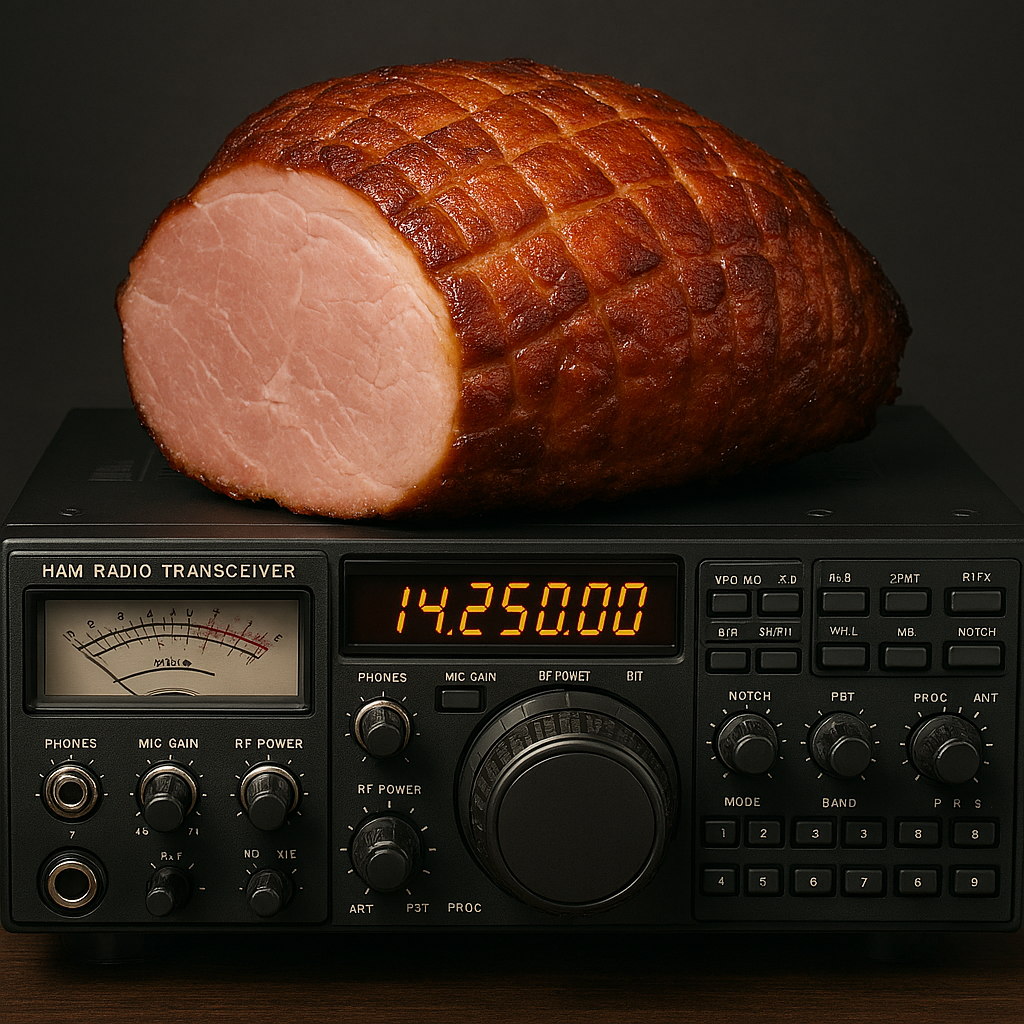
Why It’s Called “Ham”
Ever wonder why we proudly call ourselves “hams”? It’s not exactly a word that screams technical excellence.

Here’s the real story behind the name, and some myths and tall tales.


The word “Ham” didn’t start out as a compliment
Back in the landline telegraph days (when dinosaurs walked the Earth, and news came via Pony Express), professional operators had a reputation to protect. They took pride in clean, crisp sending. If someone was sloppy or heavy-handed on the key, they’d call him a “ham” — basically short for ham(mer)-fisted. It was a put-down. That usage shows up in the late 1800s, well before amateur radio really took off.

When wireless amateurs came along in the early 1900s, the pros didn’t think much of them either. Young experimenters with homemade gear tying up the airwaves? Easy targets. The label stuck.

But here’s the interesting part — the amateurs embraced it.

By around 1909, U.S. radio operators were already calling each other
“hams.” By the 1920s, the term was everywhere. What started as an insult slowly turned into a badge of honor. That’s usually how these things go. If you can’t stop a nickname, you own it.

Now, there are other stories floating around:
  • One says “HAM” came from the initials of Hertz, Armstrong, and Marconi. Sounds clever, but there’s no historical proof behind it. It shows up much later and reads more like a back-filled explanation than the real thing.

  • Another popular tale involves the Harvard Radio Club — operators named Hyman, Almy, and Murray supposedly using “HAM” as a call sign. It’s a good story, and it gets repeated a lot. But solid documentation tying it to the actual origin of the word just isn’t there.

When you strip away the folklore, most serious radio historians land in the same place:
“Ham” started as telegrapher slang for a clumsy operator, and early wireless amateurs adopted it — then wore it proudly.

That explanation fits the timeline. It fits the culture of the time. And most importantly, it lines up with the earliest written evidence we have.

Everything else is interesting — but the telegraph-slang origin is the one that holds up.

Further Reading:

Amateur radio history and overview (Britannica) –
https://www.britannica.com/technology/amateur-radio
Amateur radio (Wikipedia) –
https://en.wikipedia.org/wiki/Amateur_radio
Etymology of “ham radio” (Wikipedia) –
https://en.wikipedia.org/wiki/Etymology_of_ham_radio
History of amateur radio (Wikipedia) –
https://en.wikipedia.org/wiki/History_of_amateur_radio


This article is reprinted with permission of the author, Christopher Krstanovic - AI2F.
About Author
Christopher Krstanovic, AI2F, is a lifelong amateur radio operator, first licensed in the US in 1980s as WR1F. He holds degrees in Physics and a PhD in Electrical Engineering, and his career has spanned corporate engineering as well as technology entrepreneurship. After leaving corporate America, he founded and led three companies before returning to active amateur radio under his current call sign. His operating interests include HF, antenna design, practical radio engineering, Astronomy.

Copyright 2026 © Cabarrus Amateur Radio Society. All Rights Reserved.